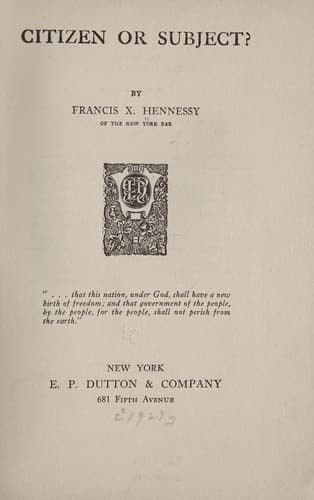
Constitutional history -- United States; United States -- Politics and government; United States. Constitution. 18th Amendment
or such addition would better secure and protect American individual
liberty.
_That_ not one of the briefers _did_ make _our_ challenge is our
certain knowledge when we read the four challenges they did make and
which are negatived in the first four conclusions of the Court.
The first two relate to the manner of the _proposal_ that governments
create government of men in America. Who cares _how_ one government
makes a silly _proposal_? The one important thing is that no
governments shall attempt _to act upon_ a proposal which denies the
most important legal fact in America, that _governments_ cannot
constitute new government ability to interfere with individual liberty.
The fourth challenge that was made is the absurd challenge that the
Fifth Article does not _mention_ a CONSTITUTIONAL mode of procedure in
which the citizens of America may again _directly_ grant to _their_
government new power to interfere with their own individual liberty
and in which--far more important to the “conventions” which named
themselves (the “conventions”) in their Fifth Article--the American
citizens can directly take back any part of the granted power of the
First Article which they find oppressive to their individual liberty.
This challenge neither knows nor makes any distinction between the
state “legislatures” and the “conventions” of the American citizens or
the mention of either in the Fifth Article. It is a challenge which has
not the knowledge we bring from the first “conventions,” the knowledge
that “legislatures” are mentioned on account of their existing ability
to make _federal_ or declaratory Articles and that “conventions” are
mentioned on account of their exclusive ability to make Articles _of
any kind_. It is a challenge which assumes and asserts and is based
wholly upon the absurd assumption that the Fifth Article is a “grant”
of power to make Articles. On this absurd assumption of this patently
absurd “grant,” this fourth challenge, frankly stated in our own words,
is as follows: “In the Fifth Article, the ‘conventions’ grant to the
two grantees--the grantors and the state legislatures--an _identical_
ability to make new Articles. We admit that, if the ‘conventions’
of the Fifth Article could constitutionally make the Eighteenth
Amendment, the state legislatures can also constitutionally make it.
But our challenge is that the ‘grant,’ in the Fifth Article, is limited
in extent and that neither the ‘conventions’ nor the state legislatures
can constitutionally make the Eighteenth Amendment.”
Public-domain text, read in full here on John Shaqi.
Reviews
Reviews
No reviews yet
Be the first to share your thoughts on this work.
Elsewhere in the archive
Join the Discussion
Join the discussion
Sign in to leave a comment or review.
Sign InorCreate an account