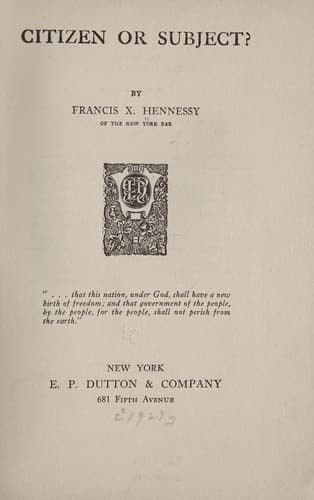
Constitutional history -- United States; United States -- Politics and government; United States. Constitution. 18th Amendment
If any one proposition could command the universal assent of mankind
[except those _for_ the validity of the Eighteenth Amendment], we
might expect it would be this:--That the government of the Union,
though limited in its powers, is supreme within its sphere of action.
This would seem to result necessarily from its nature. It is the
government of all; _its powers are delegated by all_; it represents
all, and acts for all. Though any one state may be willing to control
its operations, _no state_ is willing to allow _others_ to control
them. The nation, on those subjects on which it can act, must
necessarily bind its component parts.
Among other things, this statement, itself but a repetition of
everything that we have learned by our experience with early Americans,
emphasizes the important fact that the nation, which is ourselves, has
but one government, the government “limited in its power.” Which fact
clearly demonstrates that the state governments, not being that one
government of “limited powers,” are not the attorneys in fact for the
citizens of _America_, in any matter whatsoever, and cannot command us,
as they attempt to do in the First Section, or grant power to command
us, as they attempt to do in the Second Section of the Eighteenth
Amendment.
Again this same decision of Marshall holds clearly: “In America, the
powers of sovereignty are divided between the governments of the Union
and those of the State.” The claimed ability of the Hughes government
clients, their claimed ability to _make_ the NATIONAL new Article in
our Constitution, rests entirely upon the absurd doctrine that, _above_
the two sovereignties which Marshall names, there is an omnipotent
legislative sovereignty, without any constitutional restraint, the
sovereignty of three fourths of the very state governments which
Marshall mentions.
Public-domain text, read in full here on John Shaqi.
Reviews
Reviews
No reviews yet
Be the first to share your thoughts on this work.
Elsewhere in the archive
Join the Discussion
Join the discussion
Sign in to leave a comment or review.
Sign InorCreate an account