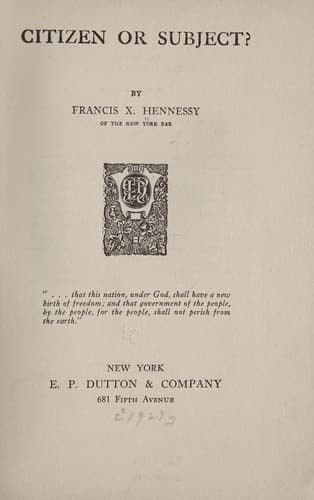
Constitutional history -- United States; United States -- Politics and government; United States. Constitution. 18th Amendment
We recall our search to know “when” and “how,” between 1907 and
1917, we became subjects. We remember the first glance at the briefs
of 1920. We remember the tribute of one to the simple truth that
“the people do not become a legislature.... As well confound the
creator and the creature--the principal and the agent through which
he acts.” We wonder why the author of this tribute did not challenge
the monumental error of the concept that the Fifth Article (when it
mentions the “conventions” of the American citizens, the greatest
principal in America, and also mentions the state governments, each as
the attorney in fact of another and distinct principal, the citizens
of its own state) is a grant from the great principal to itself and
these mentioned attorneys in fact of others. But we now know why the
author of the tribute made no such challenge. He is Hughes, who rests
his entire argument _on_ the monumental error. We remember, as we
glance at the briefs, that another one challenged the doctrine on which
Sheppard proposed that the Eighteenth Amendment be sent to governments
of state citizens, that such governments might interfere with the
freedom of _American_ citizens. We remember the Sheppard doctrine
as the Calhoun heresy that the states, political entities, made the
Constitution which _we_, the citizens of America, actually made in
our “conventions.” We remember how refreshed we were to find, in our
first glance at the briefs, this statement: “The Constitution is not
a compact between states. It proceeds directly from the people. As
was stated by Mr. Chief Justice Marshall in M’Culloch v. Maryland, 4
_Wheat._ 316, &c.” We remember our thought, when we had just come from
those “conventions,” to find this statement in that brief. We remember
how we anticipated this briefer telling the Court why the states
or _their_ governments, who could not make the First Article, were
incompetent to make the only other supposed grant of power to interfere
with our liberty, the Eighteenth Amendment. Now that we have finished
with the briefs of 1920, we recognize how absurd was our expectation.
The statement that the states, which are mere political entities, did
not make the Constitution, the quotation from Marshall, supporting this
truth and showing that the states did not make it because the states
and their governments cannot make _national_ Articles, are both from
the brief of this same Hughes, the champion of his government clients
and their claimed ability to make _national_ Articles.
Public-domain text, read in full here on John Shaqi.
Reviews
Reviews
No reviews yet
Be the first to share your thoughts on this work.
Elsewhere in the archive
Join the Discussion
Join the discussion
Sign in to leave a comment or review.
Sign InorCreate an account