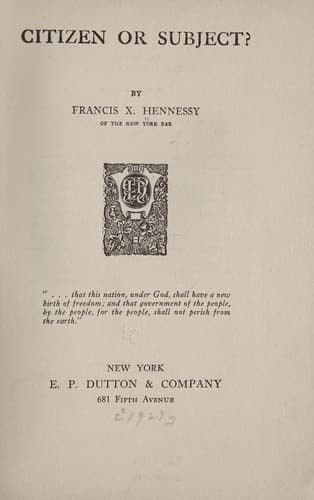
Constitutional history -- United States; United States -- Politics and government; United States. Constitution. 18th Amendment
We know, with certainty, that the Eighteenth Amendment is not in our
Constitution, and we know that the real and invincible challenge to
its existence has never been made. What will be the epitaph of the
audacious attempt of government to dictate to Americans as “subjects,”
when the challenge is presented to the Supreme Court? No patriotic
American can have the slightest doubt. No man, familiar with its
history and traditions, can fail to know the answer of that Court to
the question, “Citizen or Subject?”
It is not unknown that there is growing up in America, even among many
public leaders and lawyers, an unfounded concept that the Supreme
Court was created by the American citizens _to make_ law. Such
concept is quite in accord with the concept--indeed it is part of the
concept--that government can create and constitute new government
of men. But the entire history and tradition of the Supreme Court
flatly denies the existence of any such concept in the mind of the
Court itself. Even in the National Prohibition Cases, the Court
quickly displayed the American concept of the relation of men to all
governments in America. When the lawyers had finished their incessant
talk about the imaginary Fifth Article “grant” which would make all
American citizens “subjects” of some governments of state citizens, had
the Tory concept of such a grant made the slightest impression upon
the mind of the Court? We all know that in the decisions, which merely
negatived four unsound challenges to the Amendment, the first statement
of the Court was a reference to the power “RESERVED” in the Fifth
Article.
And we know how, in the same litigations, the Court wholly ignored
the absurd claim, even when advanced by a former justice of the
Court, that, when governments had attempted to put anything into our
Constitution, so long as the attempt did not involve changing the
number of senators from a state, the Court was without power to review
the action of governments or to protect the American citizen against
usurpation by government.
The Constitution is not only the same in words, but the same in
meaning, and delegates the same powers to the government, and reserves
and secures the same rights and privileges to the citizen, and as
long as it continues to exist in its present form, it speaks not only
in the same words, but with the same meaning and intent with which
it spoke when it came from the hands of its framers and was voted on
and adopted _by the people of the United States_. Any other rule of
construction would abrogate the judicial character of the Court, and
make it the mere reflex of the popular opinion or passion of the day.
This Court was not created by the Constitution for such purposes.
Higher and graver trusts have been confided to it, and it must not
falter in the path of duty. (Scott v. Sandford, 19 _How._ 393, at p.
426.)
Public-domain text, read in full here on John Shaqi.
Reviews
Reviews
No reviews yet
Be the first to share your thoughts on this work.
Elsewhere in the archive
Join the Discussion
Join the discussion
Sign in to leave a comment or review.
Sign InorCreate an account