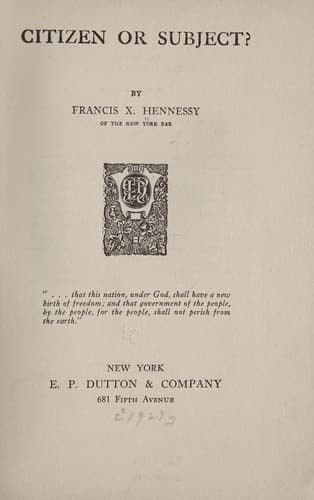
Constitutional history -- United States; United States -- Politics and government; United States. Constitution. 18th Amendment
The high power has been conferred upon this Court of passing judgment
upon the acts of the state sovereignties and of the legislative and
executive branches of the federal government, of determining whether
they are beyond the limits of power marked out for them respectively
by the Constitution of the United States. (Luther v. Borden, 1849, 7
_How._ 1 at p. 47.)
The Court will never be called upon to exercise a higher or graver
trust than to answer the question “Citizen or Subject?”, when the real
challenge is made to the new attempted constitution of government of
men entirely by government. The Court is not unaware that the whole
American people established their Constitution for the one purpose of
protecting individual liberty.
The simple, classical, precise, yet comprehensive language in
which it is couched, leaves, at most, but very little latitude for
construction; and when its intent and meaning is discovered, nothing
remains but to execute the will of those who made it, in the best
manner to effect the purposes intended. The great and paramount
purpose was to unite this mass of wealth and power, for the protection
of the humblest individual; his rights, civil and political, his
interests and prosperity, are the sole _end_; the rest are nothing but
the _means_. (Justice Johnson, Gibbons v. Ogden, 9 _Wheat._ 1, at p.
223.)
Nor will anyone familiar with the unbroken tradition of the Supreme
Court listen, with aught but mingled incredulity and indignation, to
the suggestion that the Court itself has not always understood that it
is itself but a part of the _limited_ government of the one American
people, created by that people as one means to that sole end.
“It is emphatically the province and duty of the Judiciary Department
to say what the law _is_.”
This is the clear statement of Marshall in Marbury v. Madison, 1
_Cranch._ 137, declaring unconstitutional a section of an act of
Congress, which had been passed at the first session in 1789. The
entire Bench and Bar of America, including the Supreme Court, for
fourteen years, had practiced on the assumption that the section was
constitutional. Yet in 1803, the Supreme Court declared it to be
unconstitutional. Nothing could more clearly establish the knowledge of
the Supreme Court that no continued thought (even by the Court itself),
that any command of legislatures is valid, will ever blind the Court to
its bounden duty to announce the fact that the command was made without
authority from the people, when that fact is once made clear to the
Court.
Exactly the same attitude was taken by the Court in relation to an
income tax and a _federal_ limitation on a _national_ power given to
impose direct taxation.
When that federal limitation was imposed it was aimed only at taxation
on land and at what were then known as “poll” or “capitation” taxes.
In the days of the “conventions” where we have sat, all other kinds of
taxation were deemed to be indirect taxation.
Public-domain text, read in full here on John Shaqi.
Reviews
Reviews
No reviews yet
Be the first to share your thoughts on this work.
Elsewhere in the archive
Join the Discussion
Join the discussion
Sign in to leave a comment or review.
Sign InorCreate an account