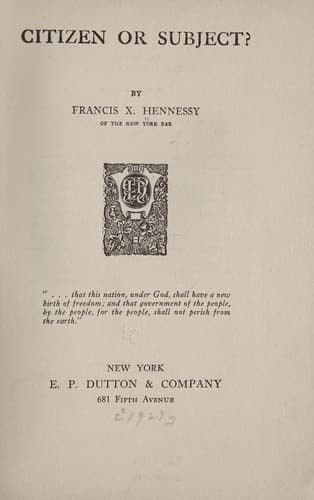
Constitutional history -- United States; United States -- Politics and government; United States. Constitution. 18th Amendment
And so the average American citizen will look forward with certainty
to the decision of that Court when the _real_ challenge is made to
the existence of the Eighteenth Amendment by an American who does
know and assert the plain facts which mean that either there is no
Eighteenth Amendment or there never has been an American citizen.
It _is_ simple fact that the existence of the Eighteenth Amendment,
that government-made constitution of government of men, is absolutely
incompatible with the existence of a citizen of America. It _is_ simple
fact that the Fifth Article did not grant to state governments or to
any governments the ability to make Articles like the First Article or
the Eighteenth Amendment, or else the Fifth Article made all Americans
“subjects” of a part of the state governments, with omnipotent ability
in those governments to legislate for Americans “in all matters
whatsoever.”
And it is simple fact that the Supreme Court must and will--when the
real challenge is at last made--decide that the Eighteenth Amendment is
not in the _national_ part of the American Constitution because it was
made by governments and not by the “conventions” of the Fifth Article.
Otherwise, in the face of history, in the face of the record of the
“conventions” of the American citizens, and in the face of all that
the Supreme Court has hitherto decided, the Court must decide that the
American citizen has never existed. The possibility that there should
be such a decision is absolutely beyond conception.
What the decision _will_ be was long ago foreshadowed and forecast
by Daniel Webster. It would almost seem as if Webster had heard the
Sheppard claim that the states made the Constitution and that the
states had then agreed between themselves that the governments of
thirty-six of the states, in combination, could command the American
citizen in any matter of his individual freedom. It would almost seem
as if Webster had heard Hughes deny, while his associate lawyers
for the Eighteenth Amendment still asserted with Sheppard, that the
Constitution was a compact between states and then had heard them all
insist that the Fifth Article was a “grant” which made thirty-six
governments of state citizens an omnipotent Parliament over all
citizens of America.
Public-domain text, read in full here on John Shaqi.
Reviews
Reviews
No reviews yet
Be the first to share your thoughts on this work.
Elsewhere in the archive
Join the Discussion
Join the discussion
Sign in to leave a comment or review.
Sign InorCreate an account