Short stories, French -- Translations into English; World War, 1914-1918 -- Fiction
TRANSCRIBER’S NOTES:
In the plain text version text in italics is enclosed by underscores
(_italics_) and small capitals are represented in upper case as in
SMALL CAPS.
A number of words in this book have both hyphenated and non-hyphenated
variants. For the words with both variants present the one more used
has been kept.
Obvious punctuation and other printing errors have been corrected.
The book cover was modified by the transcriber and has been added to
the public domain.
* * * * *
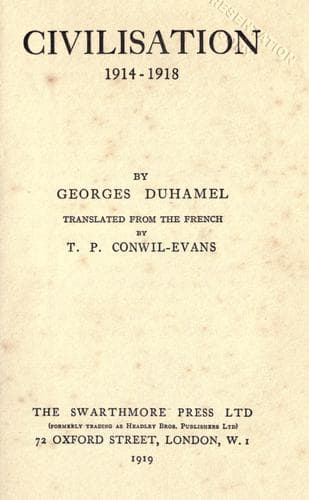
CIVILISATION
1914-1918
BY
GEORGES DUHAMEL
TRANSLATED FROM THE FRENCH
BY
T. P. CONWIL-EVANS
THE SWARTHMORE PRESS LTD
(FORMERLY TRADING AS HEADLEY BROS. PUBLISHERS LTD)
72 OXFORD STREET, LONDON, W. 1
1919
TRANSLATOR’S NOTE
With the exception of, perhaps, “Le Feu” by Henri Barbusse, no book
made such a stir in the France of 1914-1918 as Georges Duhamel’s[1]
“Civilisation.” Its success was as immediate as its appeal was
universal. Like “Le Feu,” it was awarded the Prix Goncourt, and ran to
an enormous circulation.
There is no doubt, too, that posterity will acclaim it as a remarkable
work. For it is something more than a human document of the war.
One feels in the poignant experiences of the few French soldiers,
depicted by M. Duhamel, the tragic fate of twentieth-century man--the
Machine Age man--in the grip of the scientific monster he has created
for himself. These intimate pictures have the cumulative effect of
an epic in which the experiment of humanity is menaced by man’s own
inventiveness and heroism.
This impression is the creation of the particular style of M. Duhamel.
It is not by the vigorous simplicity of a Guy de Maupassant that he
achieves his effects, nor by the exact observation which one might
expect of him as a doctor of medicine. His strength lies in the
violent imagery with which he intensifies his descriptions, giving the
impression of life and feeling to inanimate objects. He thus often
produces the effect of a monstrous dream or nightmare.
Emile Zola was a past master of this method; but, in his case, too
often, the subject did not lend itself to such treatment. M. Duhamel
does not lay himself open to this objection. No style could be more
appropriate than his for expressing the cold precision of the machinery
by means of which this so effectively organised war has ruined our
world.
Like Emile Zola, M. Duhamel does not shirk any detail however
unpleasant. Differences in language and point of view make it
impossible to reproduce all of these. But with the exception of “Les
Amours de Ponceau” all the tales comprising “Civilisation” are included
in the translation.
Public-domain text, read in full here on John Shaqi.
Reviews
Reviews
No reviews yet
Be the first to share your thoughts on this work.
Join the Discussion
Join the discussion
Sign in to leave a comment or review.
Sign InorCreate an account