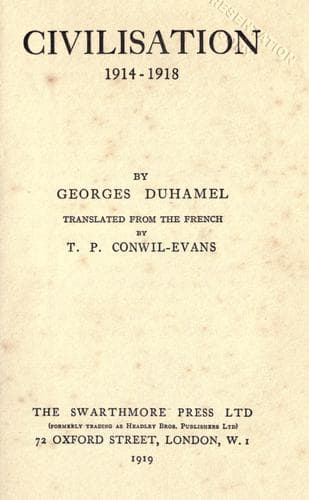
Short stories, French -- Translations into English; World War, 1914-1918 -- Fiction
And they went on gravely chatting and gulped down cupfuls of a hot
brew which was poured from a metal jug. From another angle in the tent
the scene was very different. The men were lying down: they had grave
wounds. Placed side by side on the uneven ground, they made a mosaic
of pain stained with mud and blood, the colours of war; reeking with
sweat and corruption, the smells of war; noisy with cries, moans and
hiccups which are the sounds and music of war.
I shivered at the sight. I had known the bristling horror of the
massacre and the charge. I was to learn another horror, that of the
_tableau_--the accumulation of prostrate victims, the spectacle of the
vast hall swarming with human larvæ, in heaps, on the floor.
I had finished my work with the stretcher and hastened to make my round
of the wounded. I was so deeply moved that I was rather hindered in
my work. Some of the men were vomiting, suffering unutterable agony,
and their brows streaming with perspiration. Others were very quiet
and could be more or less rational: they seemed to be following the
internal progress of their illness. I was completely upset by one of
them. He was a fair-haired sergeant with a slight moustache. His face
was buried in his hands and he was sobbing with despair and what seemed
like shame. I asked him if he was suffering pain. He scarcely replied.
Then, gently lifting his blanket, I saw that he had been terribly hit
by grape shot in his virility. And I felt a deep pity for his youth and
his tears.
There was also a boy who used to utter a queer plaint, current in his
locality. But I could only catch these syllables: “Ah! mon ... don....”
A doctor who was passing said to him:
“Come, come! a little patience! Do not cry out like that.”
The child paused a moment before replying: “I’d have to lose my voice
first if I’m not to cry.”
His neighbour was a big, rough, good-natured fellow with a powerful
jaw, strong and massive features, with the peculiar shape of the skull
and growth of hair that characterise the folk of Auvergne.
He looked at the boy who was groaning at his side, and, turning to me,
commented, with a shrug of the shoulders:
“Rotten luck being hit like that, poor child!”
“And what’s the matter with you?” I said to him.
“Oh, I think I have lost my feet; but I am fairly strong and my body is
solid.”...
It was true! I saw that both his feet had been torn away.
Round the electric arcs, luminous rings were formed by the sickening
vapour. On the sides of the tent, in the folds, you could see the flies
sleeping in big black patches, overcome by the cold freshness of night.
Large waves rolled on the canvas, passing like a shudder or violently
flapping, according as the wind or gunfire was the cause.
I stepped carefully over some stretchers and found myself outside,
in a night that roared, illuminated by the aurora borealis of the
battlefield.
Public-domain text, read in full here on John Shaqi.
Reviews
Reviews
No reviews yet
Be the first to share your thoughts on this work.
Join the Discussion
Join the discussion
Sign in to leave a comment or review.
Sign InorCreate an account