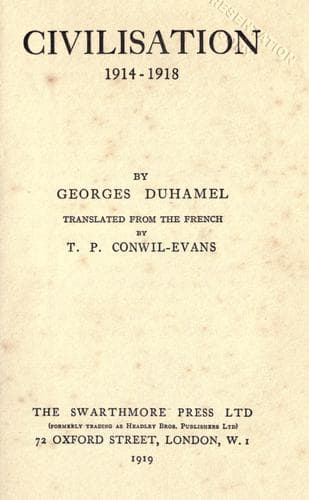
Short stories, French -- Translations into English; World War, 1914-1918 -- Fiction
He said this in a voice that was emphatic but very weak--a voice made
with the lips alone.
The blood ceased to flow, and they carried Cousin once again to the
operating-table. There, he had a moment’s peace. The surgeons were
washing their hands. I heard them consulting in low voices on Cousin’s
case, and this made my heart beat and dried the tongue in my mouth.
Cousin saw me a long way off, and made me a little sign with his
eyelids. I came close to him. He said to me:
“One never gets any peace. Ah! what was it I was saying to you? Yes, I
was talking to you about styles. My strong point is that I understand
the different styles--the Louis XV, the Empire, the Dutch, the Modern,
and all the others. But it’s difficult. I want to explain to you----”
“Go to sleep, Cousin,” said the surgeon softly.
“I will explain all that to you when these gentlemen have done with me,
when I wake up.”
Then, submissively, he began to breathe in the ether.
* * * * *
It is now a year since all this happened. I often think of the
explanations that Cousin never gave me--that he will never give me.
THE LADY IN GREEN
I do not know why I loved Rabot. Every morning as I went to and fro at
my usual work in the ward, I saw Rabot, or rather Rabot’s head, or less
still Rabot’s eye, hiding in a hurly-burly of sheets. He was a little
like a guinea-pig that rubs its nose in the straw and watches you
anxiously.
Every time I passed I made a familiar sign to Rabot. This sign
consisted in shutting the left eye energetically and pressing the lips
together. At once Rabot’s eye shut itself, digging a thousand little
wrinkles in the withered face of the sick man. And that was all; we had
exchanged our salutations and our confidences.
Rabot never laughed. He had spent his babyhood in a foundling hospital
and had not had enough milk. This under-feeding in infancy can never be
made up for afterwards.
Rabot was sandy-haired, with a pale complexion splashed with freckles.
He had so little brain that he looked like a rabbit or a bird. Directly
a stranger spoke to him his underlip began to tremble and his chin
wrinkled all over like a walnut. You had first of all to explain to him
that you were not going to beat him.
Poor Rabot! I would have given anything to see him laugh. Everything,
on the contrary, seemed to conspire to make him cry: there were the
terrible endless dressings that had to be renewed every day for months;
then he was compelled to lie so quiet and motionless that he was never
able to play with his comrades. And after all, the fact remained
that Rabot had never learned to play at all, and really was not much
interested in anything.
I was, I think, the only one who became at all intimate with him; and,
as I said before, this intimacy consisted chiefly in shutting my left
eye when I passed near his bed.
Public-domain text, read in full here on John Shaqi.
Reviews
Reviews
No reviews yet
Be the first to share your thoughts on this work.
Join the Discussion
Join the discussion
Sign in to leave a comment or review.
Sign InorCreate an account