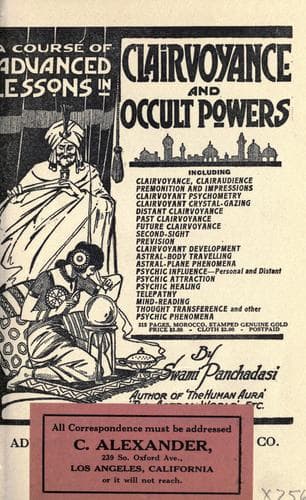
Clairvoyance and Occult PowersAtkinson, William Walker
Religion
Clairvoyance and Occult Powers
Atkinson, William Walker
Clairvoyance
These so-called practical persons have much to say regarding their senses.
They are fond of speaking of "the evidence of my senses." They also have
much to say about the possession of "good sense" on their part; of having
"sound common sense"; and often they make the strange boast that they have
"horse sense," seeming to consider this a great possession. Alas, for the
pretensions of this class of persons. They are usually found quite
credulous regarding matters beyond their everyday field of work and
thought, and accept without question the most ridiculous teachings and
dogmas reaching them from the voice of some claimed authority, while they
sneer at some advanced teaching which their minds are incapable of
comprehending. Anything which seems unusual to them is deemed "flighty,"
and lacking in appeal to their much prized "horse sense."
But, it is not my intention to spend time in discussing these
insignificant half-penny intellects. I have merely alluded to them in
order to bring to your mind the fact that to many persons the idea of
"sense" and that of "senses" is very closely allied. They consider all
knowledge and wisdom as "sense;" and all such sense as being derived
directly from their ordinary five senses. They ignore almost completely
the intuitional phases of the mind, and are unaware of many of the higher
processes of reasoning.
Such persons accept as undoubted anything that their senses report to
them. They consider it heresy to question a report of the senses. One of
their favorite remarks is that "it almost makes me doubt my senses." They
fail to perceive that their senses, at the best, are very imperfect
instruments, and that the mind is constantly employed in correcting the
mistaken report of the ordinary five senses.
Not to speak of the common phenomenon of color-blindness, in which one
color seems to be another, our senses are far from being exact. We may,
by suggestion, be made to imagine that we smell or taste certain things
which do not exist, and hypnotic subjects may be caused to see things that
have no existence save in the imagination of the person. The familiar
experiment of the person crossing his first two fingers, and placing them
on a small object, such as a pea or the top of a lead-pencil, shows us how
"mixed" the sense of feeling becomes at times. The many familiar instances
of optical delusions show us that even our sharp eyes may deceive
us--every conjuror knows how easy it is to deceive the eye by suggestion
and false movements.
Public-domain text, read in full here on John Shaqi.
Reviews
Reviews
No reviews yet
Be the first to share your thoughts on this work.
Join the Discussion
Join the discussion
Sign in to leave a comment or review.
Sign InorCreate an account