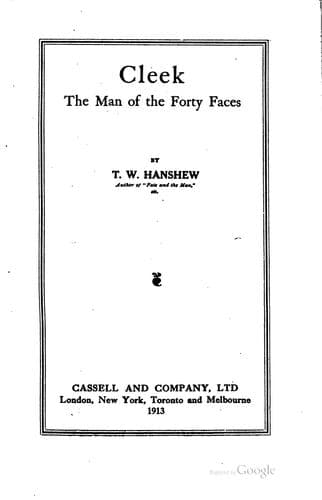
Cleek: the Man of the Forty FacesHanshew, Thomas W.
General
Cleek: the Man of the Forty Faces
Hanshew, Thomas W.
Cleek, Hamilton (Fictitious character) -- Fiction; Detective and mystery stories; Police -- Great Britain -- Fiction
"No, three--three, last Thursday, the fourteenth. A woman doesn't forget
the date of her enforced abdication. The new Lady Wyvern soon let me
know that I was a superfluous person in the household. To-day, I came to
the conclusion to leave it; and have taken the first actual step toward
doing so. A lucky step, too, I fancy; or, at least, it promises to be."
"As how?"
"My friend knows of two people who would be likely to need me: one, a
titled lady here in England, who might be 'very glad to have me'--I am
quoting that, please--as governess to her little boy. The other, a young
French girl who is returning shortly to Paris, who also might be 'glad
to have me' as companion. Of course, I would sooner remain in England,
but--well, it is nicer to be a companion than a governess; and the young
lady is very nearly my own age. Indeed, we were actually at the same
school together when we were very little girls."
"I see," said Cleek, a trifle gloomily. "So then it is possible that it
will, eventually, be the young French lady and--Paris, in future. When,
do you fancy? Soon?"
"Oh, I don't know about that. I haven't quite made up my mind as yet
which of the two it will be. And then there's the application to be sent
afterwards."
"Still, it will be one of the two certainly?"
"Oh, yes. I shall have to earn my living in future, you know; so,
naturally, of course--" She gave her shoulder an eloquent upward
movement, and let the rest go by default.
Cleek did not speak for a moment: merely walked on beside her--a ridge
between his eyebrows and his lower lip sucked in; as if he were mentally
debating upon something and was afraid he might speak incautiously. But
of a sudden:
"Miss Lorne," he said, in a curiously tense voice, "may I ask you
something? Let us say that you had set your heart upon obtaining one or
the other of these two positions--set it so entirely that life wouldn't
be worth a straw to you if you didn't get it. Let us say, too, that
there was something you had done, something in your past which, if
known, might utterly preclude the possibility of your obtaining what you
wanted--it is an absurd hypothesis, of course: but let us use it for the
sake of argument. We will say you had done your best to live down that
offensive 'something' done, and were still doing all that lay in your
power to atone for it; that nobody but one person shared the knowledge
of that 'something' with you, and upon his silence you could rely. Now
tell me: would you feel justified in accepting the position upon which
you had set your heart _without_ confessing the thing; or would you feel
in duty bound to speak, well knowing that it would in all human
probability be the end of all your hopes? I should like to have your
opinion upon that point, please."
Public-domain text, read in full here on John Shaqi.
Reviews
Reviews
No reviews yet
Be the first to share your thoughts on this work.
Join the Discussion
Join the discussion
Sign in to leave a comment or review.
Sign InorCreate an account