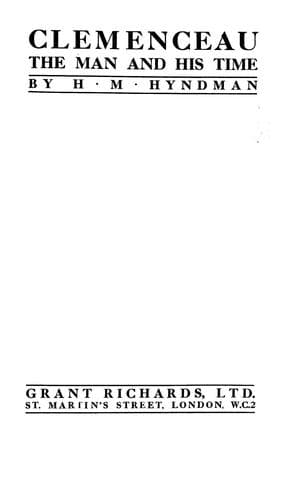
Clemenceau, the Man and His TimeHyndman, H. M. (Henry Mayers)
History
Clemenceau, the Man and His Time
Hyndman, H. M. (Henry Mayers)
Clemenceau, Georges, 1841-1929; France -- Politics and government -- 1870-1940
Such reflections would be out of place at this point, but for the fact
that Clemenceau has invariably contended that his career has been all
of a piece, maintaining that the vigorous young physiologist and doctor
of twenty-four and twenty-five held the same opinions and was moved
by the same aspirations that have guided the mature man throughout.
Whether heredity and surroundings fully account in every particular for
all that he has said, done and achieved is a question which Clemenceau
also might decline to answer with the definiteness he considers
desirable in general philosophy. But that his doctor's thesis of 1865
did in the main give the scientific basis of his material creed can
scarcely be disputed.
The following year, 1866, was the year of the Prusso-Italian war
against Austria. The success of Prussia, which would quite probably
have been a failure but for the incredible fatuity of the Imperial
clique at Vienna, was one of the chief causes, unnoted at the time,
of the downfall of Napoleon III. Few now care to recall the manner in
which the Austrian Commander-in-Chief, Marshal Benedek, was compelled
to abandon his entire strategy in deference to the pusillanimous orders
of the Emperor, or how Benedek, with a loyalty to the House of Hapsburg
which it has never at any period deserved, took upon himself the blame
of defeats for which Francis Joseph, not himself, was responsible.
But Louis Napoleon was equally blind to his own interests and those
of France when he stood aside and allowed the most ambitious and most
unscrupulous power in the world to become the virtual master of Central
Europe. It was a strange choice of evils that lay before the Radical
and Republican parties in all countries during this war. None could
wish to see upheld, still less strengthened, the wretched rule of
reactionary, tyrannous and priest-ridden Austria; yet none could look
favourably on the growth of Prussian power.
Public-domain text, read in full here on John Shaqi.
Reviews
Reviews
No reviews yet
Be the first to share your thoughts on this work.
Join the Discussion
Join the discussion
Sign in to leave a comment or review.
Sign InorCreate an account