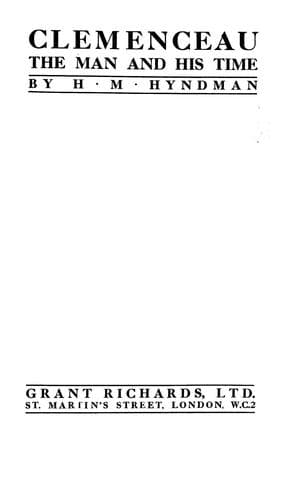
Clemenceau, the Man and His TimeHyndman, H. M. (Henry Mayers)
History
Clemenceau, the Man and His Time
Hyndman, H. M. (Henry Mayers)
Clemenceau, Georges, 1841-1929; France -- Politics and government -- 1870-1940
Though the guilty persons were well known and their German plots were
scarcely concealed, none of the Ministers responsible for the public
safety dared arrest them. Journals that were obviously published in the
interest of the enemy were allowed to spread false information as they
pleased, and to attack all statesmen and politicians who were honestly
trying to serve France with vitriolic misrepresentation. Day after
day this went on. Day after day, as the situation without grew more
precarious, the chiefs of this criminal endeavour to bring France to
ruin grew bolder in their well-paid treachery. The people of Paris and
the soldiery in the trenches, whose minds also German agents strove to
debauch with plausible lies, were becoming hopeless of justice being
done. Ministry succeeded Ministry and still the traitors were treated
with consideration by the Minister of the Interior, M. Malvy, and other
men in high place.
Beyond question the man officially responsible for all this shameful
laxity, at one of the most trying crises of the whole war, was M.
Malvy, who enjoyed the whole-souled support of the Socialist Party,
on account of creditable behaviour towards the workers, altogether
outside of questions arising from the war. But his conduct in regard
to traitors and pro-Germans had become so weak as to be capable of the
worst interpretation.
On July 24th, 1917, Clemenceau declared that he utterly distrusted
M. Malvy. It was known even thus early that this Minister had shown
deplorable incapacity in his dealings with men who are known to have
been actual traitors. He had, in fact, decided not to arrest persons
enumerated in what was called "List B," that is to say, men and women
more than suspected of criminal intrigue against France. Had not
Almereyda himself assured M. Malvy, as Minister of the Interior, that
he and all other Anarchists and anti-patriotic agitators would really
desist from their sinister proceedings? This was enough. Without
taking any steps against them, or even obtaining any security for the
fulfilment of this promise in the air, M. Malvy left these miscreants
alone to do what they pleased. So things went on as before; though, as
has since been proved, several of these active agitators for peace,
disaffection and surrender were paid agents of the German Government.
Public-domain text, read in full here on John Shaqi.
Reviews
Reviews
No reviews yet
Be the first to share your thoughts on this work.
Elsewhere in the archive
Join the Discussion
Join the discussion
Sign in to leave a comment or review.
Sign InorCreate an account