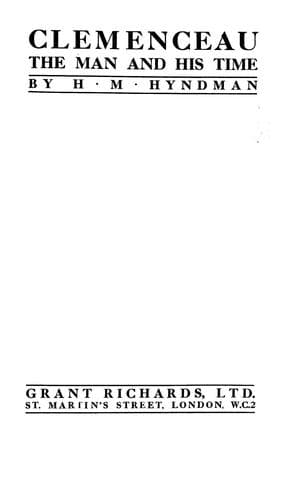
Clemenceau, the Man and His TimeHyndman, H. M. (Henry Mayers)
History
Clemenceau, the Man and His Time
Hyndman, H. M. (Henry Mayers)
Clemenceau, Georges, 1841-1929; France -- Politics and government -- 1870-1940
When, therefore, a resolution of confidence in M. Ribot's
Administration was proposed in the Senate, Clemenceau voted for the
resolution, but made special exception in the case of M. Malvy, in whom
he declared he had no confidence whatever. Later, Clemenceau boldly
accused M. Ribot and his whole Administration of being themselves
all responsible for the existence of the treacherous German Bonnet
Rouge and Bolo conspiracy. Most unfortunately, notwithstanding the
universal distrust thus awakened and spreading from Paris throughout
France, Republican Ministers, who ought to have been the first to move
to safeguard the interests of France and her Republic, against the
dangerous plots of men known to be immersed in abominable dealings with
the enemy, failed altogether in their duty. They left it to avowed
Royalists and reactionaries to lead the attack upon persons guilty of
these crimes. What, consequently, ought to have been done at once,
legally and thoroughly, by men who had received political power by vote
of the French people, and were trustees for the defence of the country,
against the foreign enemy from without and the domestic enemy within,
was left largely to be accomplished by M. Léon Daudet and M. Barrès.
These men made no secret of the fact that they were actuated by motives
entirely antagonistic to the democratic policy of the Allies and
hostile to the only form of government possible in France. This did
not render their indictment less crushing when the facts were fully
disclosed, but it certainly weakened the force of the attack. What
is more, it gave a large and, later, apparently the largest section
of the Socialist Party the excuse, which they were eager to grasp,
for supporting M. Malvy, and more particularly their friend M. Joseph
Caillaux, against what they were pleased to denounce as abominable
detraction.
Newspapers to-day are credited, perhaps, with more political influence
than they really possess. But it is clear that if nearly the whole
of the important press of a country can be captured by a particular
faction, and only such news is allowed to be published as suits the
convenience of the Government in power, the people at large have no
means of correcting the false impressions of events thus thrust upon
them. That is an extreme case, which has, so far, been realised, in
practice, in only one country. But the German agents who were so
active in Paris were fully alive to the advantages of such a policy
of purchase and manipulation of the press for their own ends. They
made efforts to secure a control of the majority of the shares in some
of the most influential journals of Paris. How far this process was
surreptitiously carried will never be known: not far enough, certainly,
to affect the tone of the organs they were anxious to manipulate.
Public-domain text, read in full here on John Shaqi.
Reviews
Reviews
No reviews yet
Be the first to share your thoughts on this work.
Elsewhere in the archive
Join the Discussion
Join the discussion
Sign in to leave a comment or review.
Sign InorCreate an account