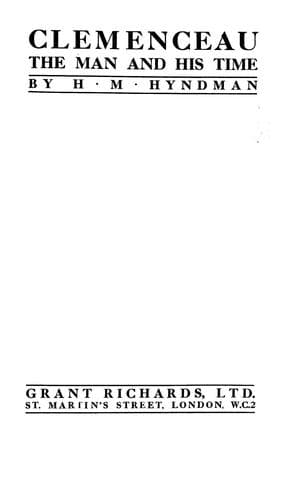
Clemenceau, the Man and His TimeHyndman, H. M. (Henry Mayers)
History
Clemenceau, the Man and His Time
Hyndman, H. M. (Henry Mayers)
Clemenceau, Georges, 1841-1929; France -- Politics and government -- 1870-1940
But enough was done to show the great danger which would have resulted
to the community, had a newspaper trust been successfully created on
the scale contemplated, but fortunately never carried out, by the
infamous Bolo Pasha and his associates. Their own journal, _Le Bonnet
Rouge_, even when increased during the war from a weekly to a daily
issue, was not by any means sufficient for their needs, although that
traitorous sheet alone was able to do a great deal of mischief. But
their control was extended to the _Journal_, a paper, prior to the
war, of considerable circulation and influence. Their attempts to
expand further were in full swing when, thanks to the work of MM. Léon
Daudet and Barrès in the _Action_ _Française_, and still more to that
of their bitter opponent Clemenceau in _l'Homme Enchaîné_ and in the
Senate, the French Government was forced to arrest the proprietors of
the _Bonnet Rouge_ and put them on their trial as traitors. It was
known that M. Caillaux and M. Paix-Séailles--the latter connected
with M. Painlevé's Cabinet and the repository of anti-French
confidences--had contributed considerable sums to the support of the
incriminated paper.
When M. Almereyda, one of the most important persons connected with the
_Bonnet Rouge_ (to whose columns a leading Socialist was a contributor)
died suddenly in prison, the editor of that journal telegraphed to M.
Caillaux concerning the lamentable departure of "our friend." As these
facts were accompanied by other revelations still more compromising,
public opinion became greatly excited. There could be no doubt that
the conspiracy was more than a mere anti-patriotic newspaper intrigue
of financial origin, or an attempt of discredited politicians to
float themselves back into office on the wave of discouragement and
defeatism: it was an endeavour, supported throughout by German funds,
to destroy French confidence in order to ensure French destruction.
A complete exposure of the whole plot, in which M. Caillaux and Bolo
Pasha were alleged to be the leading figures, was threatened in
the course of the _Bonnet Rouge_ trial. Eleven members of the Army
Committee of the Senate were appointed to consider M. Caillaux's
connection with M. Almereyda and the _Bonnet Rouge_.
M. Caillaux has been by far the most formidable advocate of a German
peace from the first. That an ex-Premier of France should take up such
a position would seem almost incredible, but that Signor Giolitti in
Italy and Lord Lansdowne in England have pursued the same course in a
less objectionable way. The political relations between Clemenceau and
M. Caillaux in the years prior to the war had not been unfriendly. M.
Caillaux had been Finance Minister in Clemenceau's Cabinet in 1907, and
they had both worked together for M. Pams against M. Poincaré in the
contest for the Presidency. But two more different personalities it
would be difficult to find.
Public-domain text, read in full here on John Shaqi.
Reviews
Reviews
No reviews yet
Be the first to share your thoughts on this work.
Elsewhere in the archive
Join the Discussion
Join the discussion
Sign in to leave a comment or review.
Sign InorCreate an account