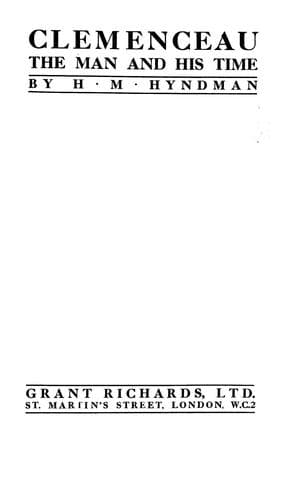
Clemenceau, the Man and His TimeHyndman, H. M. (Henry Mayers)
History
Clemenceau, the Man and His Time
Hyndman, H. M. (Henry Mayers)
Clemenceau, Georges, 1841-1929; France -- Politics and government -- 1870-1940
Clemenceau's position was a difficult one. Knowing both peasants and
Parisians intimately well, he saw clearly the very dangerous situation
which must inevitably be created by such tactics of exasperation. As
one of the deputies of Radical Republican Paris, he did his utmost
at Bordeaux to maintain the independence of his constituents and to
resist the fatal action of the majority. As the son of a landowner in
La Vendée, he understood clearly the views of the provincials and how
necessary it was that they should be thoroughly informed as to the
aims of the Parisians. But Paris had first claim on his services. He
therefore associated himself with Louis Blanc, voted with him against
the preliminaries of peace and in favour of the continuance of the war.
There was a strong opinion at this time that many of the Buonapartists
in high military command, as well as in important civil posts, were
traitors to the Republic and had acted, as Bazaine unquestionably
did, in the interest of the Imperial prisoner instead of on behalf
of France. These factionists too were hostile to Paris, and a demand
was made, in which Clemenceau joined, for a full investigation of the
conduct of such men during the siege. Unfortunately, affairs in the
capital were now becoming so critical and the probability of another
revolution there seemed so great that Clemenceau felt his duties as
Mayor of Montmartre were still more urgent than his votes and speeches
at Bordeaux, as deputy for that district. Consequently, after less than
a month's stay at Bordeaux, he returned to Paris on the evening of
March 5th. The Commune of Paris was set on foot within a fortnight of
that date, on March 18th, 1871.
CHAPTER IV
THE COMMUNE
Unquestionably, the revolt was brought about by the ill-judged and
arbitrary conduct of the agents of the National Assembly. To attempt
to seize the guns of the National Guard as a preliminary to disarming
the only Citizen force which the capital had at its disposal was as
illegal as it was provocative. It was virtually a declaration of civil
war by the reactionaries in control of the national forces. The people
of Paris were in no humour to put up with such high-handed action on
the part of men who, they knew, were opposed even to the Republic which
they nominally served. They resisted the attempt and captured the
generals, Lecomte and Thomas, who had ordered the step to be taken.
Public-domain text, read in full here on John Shaqi.
Reviews
Reviews
No reviews yet
Be the first to share your thoughts on this work.
Join the Discussion
Join the discussion
Sign in to leave a comment or review.
Sign InorCreate an account