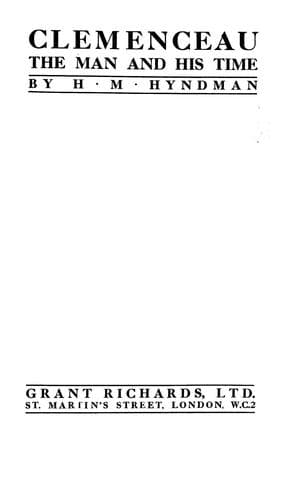
Clemenceau, the Man and His TimeHyndman, H. M. (Henry Mayers)
History
Clemenceau, the Man and His Time
Hyndman, H. M. (Henry Mayers)
Clemenceau, Georges, 1841-1929; France -- Politics and government -- 1870-1940
Freedom of person, of speech and of the press were cardinal points
in his programme. He demanded that Paris should be released from
all exceptional measures of repression inflicted by the so-called
Conservatives upon the whole of the inhabitants of the capital as
revenge for the rash action of a small number of fanatical idealists
and as a means of keeping down any agitation against their own
corruption and incompetence. He claimed also that no perpetual
disability, in the shape of imprisonment and exile, should attach to
the members of the Commune of Paris, and he called for the fullest
pardon and freedom even for the irreconcilable Anarchist, Blanqui.
On questions of political rights, universal secular education, the
separation of Church and State, the generous treatment of the rank and
file of the army, the prevention of the intrigues of the Catholics,
and the expulsion of the Jesuits, Clemenceau took the line of an
out-and-out democrat. So, likewise, in regard to the treatment of the
working classes. Though not really a Socialist, the Radical leader
recognised clearly the infinite hardships suffered by the wage-earners
under the capitalist system, and proposed and supported palliative
legislation to lessen and redress their wrongs. In foreign affairs
he was a man of peace, never forgetting the outrages committed by
the German armies in the war nor the territory seized and the huge
indemnity exacted by the German Government at the peace; but hoping
always that the friendly development of the peoples of both France and
Germany might avert further antagonism and eventually lead to a full
understanding which would assuage the hatreds of the past and lay the
foundations of mutual good feeling in the future. To colonisation by
conquest and colonial adventures generally Clemenceau was steadfastly
opposed. The entire policy of expansion he regarded as injurious to the
true interests of the country, diverting to doubtful enterprises abroad
resources which were required for the development of Republican France
at home. Such colonial schemes also were apt to create difficulties and
even to risk wars with other nations which could in no wise benefit the
people, while they might strengthen the financiers whose malefic power
was already too great.
Such in brief was the general policy which Clemenceau set himself to
formulate and put to the front on behalf of the only party which at
that moment could exercise any serious influence in the political
world. The whole programme was closely knit together, and for
many years stood the brunt of the bitterest Parliamentary warfare
conceivable. It was a conflict of ideas that Clemenceau entered upon.
He conducted it throughout on the most approved principle of all
warfare: Never fail to attack in order to defend. The advice of the
American banker, "David Harum," might have been enunciated as the motto
of Georges Clemenceau the French statesman: "Do unto others as they
would do unto you, and do it _first_."
Public-domain text, read in full here on John Shaqi.
Reviews
Reviews
No reviews yet
Be the first to share your thoughts on this work.
Join the Discussion
Join the discussion
Sign in to leave a comment or review.
Sign InorCreate an account