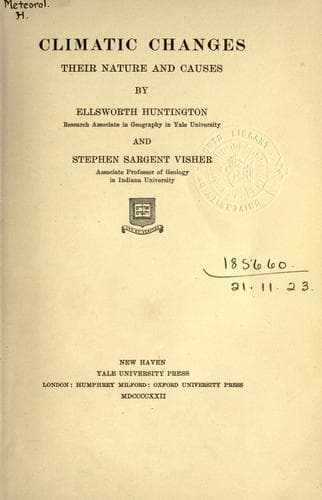
Climatic Changes: Their Nature and CausesHuntington, Ellsworth
Science
Climatic Changes: Their Nature and Causes
Huntington, Ellsworth
Climatic changes; Climatology; Paleoclimatology
When the sun's activity began to diminish, all these conditions, as well
as several others, would cooeperate to cause the ice sheets to disappear.
Step by step with their disappearance, the amelioration of the climate
would progress so long as the period of solar inactivity continued and
storms were rare. If the inactivity continued long enough, it would
result in a fairly mild climate in high latitudes, though so long as the
continents were emergent this mildness would not be of the extreme type.
The inauguration of another cycle of increased disturbance of the sun,
with a marked increase in storminess, would inaugurate another glacial
epoch. Thus a succession of glacial and inter-glacial epochs might
continue so long as the sun was repeatedly disturbed.
FOOTNOTES:
[Footnote 38: This chapter is an amplification and revision of the
sketch of the glacial period contained in The Solar Hypothesis of
Climatic Changes; Bull. Geol. Soc. Am., Vol. 25, 1914.]
[Footnote 39: R. D. Salisbury: Physical Geography of the Pleistocene, in
Outlines of Geologic History, by Willis, Salisbury, and others, 1910, p.
265.]
[Footnote 40: The Quaternary Ice Age, 1914, p. 364.]
[Footnote B: For fuller discussion of climatic controls see S. S.
Visher: Seventy Laws of Climate, Annals Assoc. Am. Geographers, 1922.]
[Footnote 41: Many of these alterations are implied or discussed in the
following papers:
1. F. W. Harmer: Influence of Winds upon the Climate of the Pleistocene;
Quart. Jour. Geol. Soc., Vol. 57, 1901, p. 405.
2. C. E. P. Brooks: Meteorological Conditions of an Ice Sheet; Quart.
Jour. Royal Meteorol. Soc., Vol. 40, 1914, pp. 53-70, and The Evolution
of Climate in Northwest Europe; _op. cit._, Vol. 47, 1921, pp. 173-194.
3. W. H. Hobbs: The Role of the Glacial Anticyclone in the Air
Circulation of the Globe; Proc. Am. Phil. Soc., Vol. 54, 1915, pp.
185-225.]
[Footnote 42: W. B. Wright: The Quaternary Ice Age, 1914, p. 100.]
[Footnote 43: The description of the distribution of the ice sheet is
based on T. C. Chamberlin's wall map of North America at the maximum of
glaciation, 1913.]
[Footnote 44: Chamberlin and Salisbury: Geology, 1906, Vol. 3, and W. H.
Hobbs: Characteristics of Existing Glaciers, 1911.]
[Footnote 45: S. S. Visher: The Geography of South Dakota; S. D. Geol.
Surv., 1918.]
CHAPTER VIII
SOME PROBLEMS OF GLACIAL PERIODS
Public-domain text, read in full here on John Shaqi.
Reviews
Reviews
No reviews yet
Be the first to share your thoughts on this work.
Elsewhere in the archive
Join the Discussion
Join the discussion
Sign in to leave a comment or review.
Sign InorCreate an account