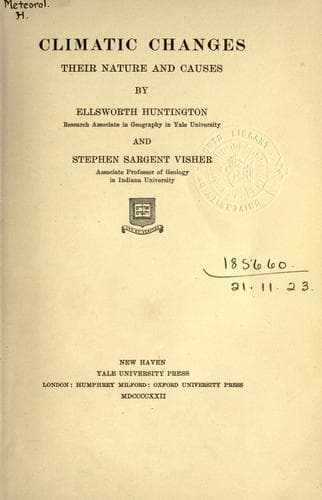
Climatic Changes: Their Nature and CausesHuntington, Ellsworth
Science
Climatic Changes: Their Nature and Causes
Huntington, Ellsworth
Climatic changes; Climatology; Paleoclimatology
Having outlined in general terms the coming of the ice sheets and their
disappearance, we are now ready to discuss certain problems of
compelling climatic interest. The discussion will be grouped under five
heads: (I) the localization of glaciation; (II) the sudden coming of
glaciation; (III) peculiar variations in the height of the snow line and
of glaciation; (IV) lakes and other evidences of humidity in unglaciated
regions during the glacial epochs; (V) glaciation at sea level and in
low latitudes in the Permian and Proterozoic eras. The discussion of
perhaps the most difficult of all climatic problems of glaciation, that
of the succession of cold glacial and mild inter-glacial epochs, has
been postponed to the next to the final chapter of this book. It cannot
be properly considered until we take up the history of solar
disturbances.
I. The first problem, the localization of the ice sheets, arises from
the fact that in both the Pleistocene and the Permian periods glaciation
was remarkably limited. In neither period were all parts of high
latitudes glaciated; yet in both cases glaciation occurred in large
regions in lower latitudes. Many explanations of this localization have
been offered, but most are entirely inadequate. Even hypotheses with
something of proven worth, such as those of variations in volcanic dust
and in atmospheric carbon dioxide, fail to account for localization. The
cyclonic form of the solar hypothesis, however, seems to afford a
satisfactory explanation.
The distribution of the ice in the last glacial period is well known,
and is shown in Fig. 6. Four-fifths of the ice-covered area, which was
eight million square miles, more or less, was near the borders of the
North Atlantic in eastern North America and northwestern Europe. The ice
spread out from two great centers in North America, the Labradorean east
of Hudson Bay, and the Keewatin west of the bay. There were also many
glaciers in the western mountains, especially in Canada, while
subordinate centers occurred in Newfoundland, the Adirondacks, and the
White Mountains. The main ice sheet at its maximum extension reached as
far south as latitude 39 deg. in Kansas and Kentucky, and 37 deg. in Illinois.
Huge boulders were transferred more than one thousand miles from their
source in Canada. The northward extension was somewhat less. Indeed, the
northern margin of the continent was apparently relatively little
glaciated and much of Alaska unglaciated. Why should northern Kentucky
be glaciated when northern Alaska was not?
Public-domain text, read in full here on John Shaqi.
Reviews
Reviews
No reviews yet
Be the first to share your thoughts on this work.
Elsewhere in the archive
Join the Discussion
Join the discussion
Sign in to leave a comment or review.
Sign InorCreate an account