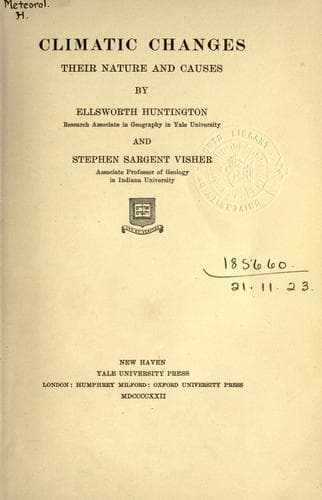
Climatic Changes: Their Nature and CausesHuntington, Ellsworth
Science
Climatic Changes: Their Nature and Causes
Huntington, Ellsworth
Climatic changes; Climatology; Paleoclimatology
In Europe the chief center from which the continental glacier moved was
the Scandinavian highlands. It pushed across the depression now occupied
by the Baltic to southern Russia and across the North Sea depression to
England and Belgium. The Alps formed a center of considerable
importance, and there were minor centers in Scotland, Ireland, the
Pyrenees, Apennines, Caucasus, and Urals. In Asia numerous ranges also
contained large glaciers, but practically all the glaciation was of the
alpine type and very little of the vast northern lowland was covered
with ice.
In the southern hemisphere glaciation at low latitudes was less striking
than in the northern hemisphere. Most of the increase in the areas of
ice was confined to mountains which today receive heavy precipitation
and still contain small glaciers. Indeed, except for relatively slight
glaciation in the Australian Alps and in Tasmania, most of the
Pleistocene glaciation in the southern hemisphere was merely an
extension of existing glaciers, such as those of south Chile, New
Zealand, and the Andes. Nevertheless, fairly extensive glaciation
existed much nearer the equator than is now the case.
In considering the localization of Pleistocene glaciation, three main
factors must be taken into account, namely, temperature, topography, and
precipitation. The absence of glaciation in large parts of the Arctic
regions of North America and of Asia makes it certain that low
temperature was not the controlling factor. Aside from Antarctica, the
coldest place in the world is northeastern Siberia. There for seven
months the average temperature is below 0 deg.C., while the mean for the
whole year is below -10 deg.C. If the temperature during a glacial period
averaged 6 deg.C. lower than now, as is commonly supposed, this part of
Siberia would have had a temperature below freezing for at least nine
months out of the twelve even if there were no snowfield to keep the
summers cold. Yet even under such conditions no glaciation occurred,
although in other places, such as parts of Canada and northwestern
Europe, intense glaciation occurred where the mean temperature is much
higher.
Public-domain text, read in full here on John Shaqi.
Reviews
Reviews
No reviews yet
Be the first to share your thoughts on this work.
Elsewhere in the archive
Join the Discussion
Join the discussion
Sign in to leave a comment or review.
Sign InorCreate an account