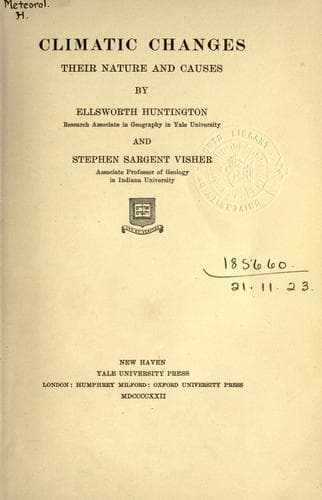
Climatic Changes: Their Nature and CausesHuntington, Ellsworth
Science
Climatic Changes: Their Nature and Causes
Huntington, Ellsworth
Climatic changes; Climatology; Paleoclimatology
times of solar activity the earth's temperature falls more at the
equator than in higher latitudes. If this effect were magnified it would
lower the snow line. The actual position of the snow line at the equator
during glacial periods thus appears to be the combined effect of
diminished precipitation, which would raise the line, and of lower
temperature, which would bring it down.
Before leaving this subject it may be well to recall that the relative
lessening of precipitation in equatorial latitudes during the glacial
epochs was probably caused by the diversion of moisture from the
trade-wind belt. This diversion was presumably due to the great number
of tropical cyclones and to the fact that the cyclonic storms of middle
latitudes also drew much moisture from the trade-wind belt in summer
when the northern position of the sun drew that belt near the storm
track which was forced to remain south of the ice sheet. Such diversion
of moisture out of the trade-wind belt must diminish the amount of water
vapor that is carried by the trades to equatorial regions; hence it
would lessen precipitation in the belt of so-called equatorial calms,
which lies along the heat equator rather than along the geographical
equator.
Another phase of the vertical distribution of glaciation has been the
subject of considerable discussion. In the Alps and in many other
mountains the glaciation of the Pleistocene period appears to have had
its upper limit no higher than today. This has been variously
interpreted. It seems, however, to be adequately explained as due to
decreased precipitation at high altitudes during the cold periods. This
is in spite of the fact that precipitation in general increased with
increased storminess. The low temperature of glacial times presumably
induced condensation at lower altitudes than now, and most of the
precipitation occurred upon the lower slopes of the mountains,
contributing to the lower glaciers, while little of it fell upon the
highest glaciers. Above a moderate altitude in all lofty mountains the
decrease in the amount of precipitation is rapid. In most cases the
decrease begins at a height of less than 3000 feet above the base of the
main slope, provided the slope is steep. The colder the air, the lower
the altitude at which this occurs. For example, it is much lower in
winter than in summer. Indeed, the higher altitudes in the Alps are
sunny in winter even where there are abundant clouds lower down.
Public-domain text, read in full here on John Shaqi.
Reviews
Reviews
No reviews yet
Be the first to share your thoughts on this work.
Elsewhere in the archive
Join the Discussion
Join the discussion
Sign in to leave a comment or review.
Sign InorCreate an account