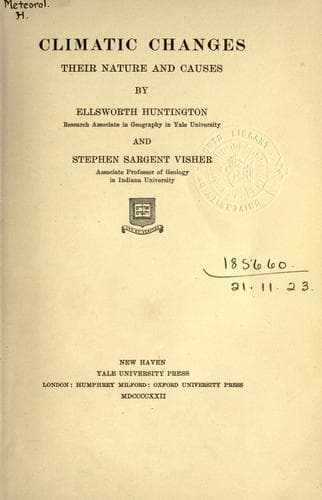
Climatic Changes: Their Nature and CausesHuntington, Ellsworth
Science
Climatic Changes: Their Nature and Causes
Huntington, Ellsworth
Climatic changes; Climatology; Paleoclimatology
IV. The presence of extensive lakes and other evidences of a pluvial
climate during glacial periods in non-glaciated regions which are
normally dry is another of the facts which most glacial hypotheses fail
to explain satisfactorily. Beyond the ice sheets many regions appear to
have enjoyed an unusually heavy precipitation during the glacial epochs.
The evidence of this is abundant, including numerous abandoned strand
lines of salt lakes and an abundance of coarse material in deltas and
flood plains. J. D. Whitney,[49] in an interesting but neglected volume,
was one of the first to marshal the evidence of this sort. More recently
Free[50] has amplified this. According to him in the Great Basin region
of the United States sixty-two basins either contain unmistakable
evidence of lakes, or belong to one of the three great lake groups named
below. Two of these, the Lake Lahontan and the Lake Bonneville groups,
comprise twenty-nine present basins, while the third, the Owens-Searles
chain, contained at least five large lakes, the lowest being in Death
Valley. In western and central Asia a far greater series of salt lakes
is found and most of these are surrounded by strands at high levels.
Many of these are described in _Explorations in Turkestan_, _The Pulse
of Asia_, and _Palestine and Its Transformation_. There has been a good
deal of debate as to whether these lakes actually date from the glacial
period, as is claimed by C. E. P. Brooks, for example, or from some
other period. The evidence, however, seems to be convincing that the
lakes expanded when the ice also expanded.
According to the older glacial hypotheses the lower temperature which is
postulated as the cause of glaciation would almost certainly mean less
evaporation over the oceans and hence less precipitation during glacial
periods. To counteract this the only way in which the level of the lakes
could be raised would be because the lower temperature would cause less
evaporation from their surfaces. It seems quite impossible, however,
that the lowering of temperature, which is commonly taken to have been
not more than 10 deg.C., could counteract the lessened precipitation and
also cause an enormous expansion of most of the lakes. For example,
ancient Lake Bonneville was more than ten times as large as its modern
remnant, Great Salt Lake, and its average depth more than forty times as
great.[51] Many small lakes in the Old World expanded still more.[52]
For example, in eastern Persia many basins which now contain no lake
whatever are floored with vast deposits of lacustrine salt and are
surrounded by old lake bluffs and beaches. In northern Africa similar
conditions prevail.[53] Other, but less obvious, evidence of more
abundant rainfall in regions that are now dry is found in thick strata
of gravel, sand, and fine silt in the alluvial deposits of flood plains
and deltas.[54]
Public-domain text, read in full here on John Shaqi.
Reviews
Reviews
No reviews yet
Be the first to share your thoughts on this work.
Elsewhere in the archive
Join the Discussion
Join the discussion
Sign in to leave a comment or review.
Sign InorCreate an account