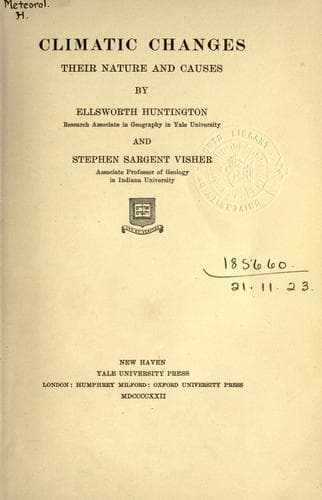
Climatic Changes: Their Nature and CausesHuntington, Ellsworth
Science
Climatic Changes: Their Nature and Causes
Huntington, Ellsworth
Climatic changes; Climatology; Paleoclimatology
The cyclonic hypothesis supposes that increased storminess accounts for
pluvial climates in regions that are now dry just as it accounts for
glaciation in the regions of the ice sheets. Figs. 2 and 3, it will be
remembered, illustrate what happens when the sun is active. Solar
activity is accompanied by an increase in storminess in the southwestern
United States in exactly the region where elevated strands of diminished
salt lakes are most numerous. In Fig. 3, the same condition is seen in
the region of salt lakes in the Old World. Judging by these maps, which
illustrate what has happened since careful meteorological records were
kept, an increase in solar activity is accompanied by increased rainfall
in large parts of what are now semi-arid and desert regions. Such
precipitation would at once cause the level of the lakes to rise. Later,
when ice sheets had developed in Europe and America, the high-pressure
areas thus caused might force the main storm belt so far south that it
would lie over these same arid regions. The increase in tropical
hurricanes at times of abundant sunspots may also have a bearing on the
climate of regions that are now arid. During the glacial period some of
the hurricanes probably swept far over the lands. The numerous tropical
cyclones of Australia, for example, are the chief source of
precipitation for that continent.[55] Some of the stronger cyclones
locally yield more rain in a day or two than other sources yield in a
year.
V. The occurrence of widespread glaciation near the tropics during the
Permian, as shown in Fig. 7, has given rise to much discussion. The
recent discovery of glaciation in latitudes as low as 30 deg. in the
Proterozoic is correspondingly significant. In all cases the occurrence
of glaciation in low and middle latitudes is probably due to the same
general causes. Doubtless the position and altitude of the mountains had
something to do with the matter. Yet taken by itself this seems
insufficient. Today the loftiest range in the world, the Himalayas, is
almost unglaciated, although its southern slope may seem at first
thought to be almost ideally located in this respect. Some parts rise
over 20,000 feet and certain lower slopes receive 400 inches of rain per
year. The small size of the Himalayan glaciers in spite of these
favorable conditions is apparently due largely to the seasonal character
of the monsoon winds. The strong outblowing monsoons of winter cause
about half the year to be very dry with clear skies and dry winds from
the interior of Asia. In all low latitudes the sun rides high in the
heavens at midday, even in winter, and thus melts snow fairly
effectively in clear weather. This is highly unfavorable to glaciation.
The inblowing southern monsoons bring all their moisture in midsummer at
just the time when it is least effective in producing snow. Conditions
similar to those now prevailing in the Himalayas must accompany any
Public-domain text, read in full here on John Shaqi.
Reviews
Reviews
No reviews yet
Be the first to share your thoughts on this work.
Elsewhere in the archive
Join the Discussion
Join the discussion
Sign in to leave a comment or review.
Sign InorCreate an account