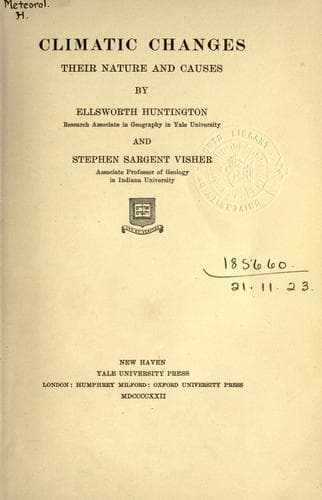
Climatic Changes: Their Nature and CausesHuntington, Ellsworth
Science
Climatic Changes: Their Nature and Causes
Huntington, Ellsworth
Climatic changes; Climatology; Paleoclimatology
It has been assumed by Marsden Manson and others that increased general
cloudiness would account for the subtropical glaciation of the Permian
and Proterozoic. Granting for the moment that there could be universal
persistent cloudiness, this would not prevent or counteract the
outblowing anti-cyclonic winds so characteristic of great snowfields.
Therefore, under the hypothesis of general cloudiness there would be no
supply of moisture to cause glaciation in low latitudes. Indeed,
persistent cloudiness in all higher latitudes would apparently deprive
the Himalayas of most of their present moisture, for the interior of
Asia would not become hot in summer and no inblowing monsoons would
develop. In fact, winds of all kinds would seemingly be scarce, for they
arise almost wholly from contrasts of temperature and hence of
atmospheric pressure. The only way to get winds and hence precipitation
would be to invoke some other agency, such as cyclonic storms, but that
would be a departure from the supposition that glaciation arose from
cloudiness.
Let us now inquire how the cyclonic hypothesis accounts for glaciation
in low latitudes. We will first consider the terrestrial conditions in
the early Permian, the last period of glaciation in such latitudes.
Geologists are almost universally agreed that the lands were
exceptionally extensive and also high, especially in low latitudes. One
evidence of this is the presence of abundant conglomerates composed of
great boulders. It is also probable that the carbon dioxide in the air
during the early Permian had been reduced to a minimum by the
extraordinary amount of coal formed during the preceding period. This
would tend to produce low temperature and thus make the conditions
favorable for glaciation as soon as an accentuation of solar activity
caused unusual storminess. If the storminess became extreme when
terrestrial conditions were thus universally favorable to glaciation, it
would presumably produce glaciation in low latitudes. Numerous and
intense tropical cyclones would carry a vast amount of moisture out of
the tropics, just as now happens when the sun is active, but on a far
larger scale. The moisture would be precipitated on the equatorward
slopes of the subtropical mountain ranges. At high elevations this
precipitation would be in the form of snow even in summer. Tropical
cyclones, however, as is shown in _Earth and Sun_, occur in the autumn
and winter as well as in summer. For example, in the Bay of Bengal the
number recorded in October is fifty, the largest for any month; while in
November it is thirty-four, and December fourteen as compared with an
average of forty-two for the months of July to September. From January
to March, when sunspot numbers averaged more than forty, the number of
tropical hurricanes was 143 per cent greater than when the sunspot
numbers averaged below forty. During the months from April to June,
which also would be times of considerable snowy precipitation, tropical
Public-domain text, read in full here on John Shaqi.
Reviews
Reviews
No reviews yet
Be the first to share your thoughts on this work.
Elsewhere in the archive
Join the Discussion
Join the discussion
Sign in to leave a comment or review.
Sign InorCreate an account