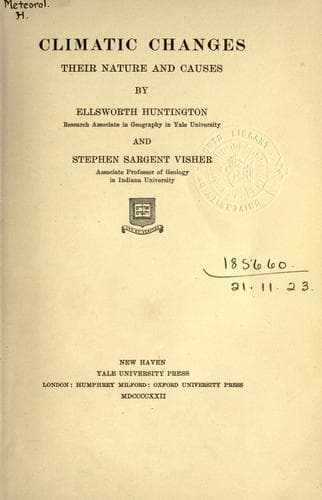
Climatic Changes: Their Nature and CausesHuntington, Ellsworth
Science
Climatic Changes: Their Nature and Causes
Huntington, Ellsworth
Climatic changes; Climatology; Paleoclimatology
hurricanes averaged 58 per cent more numerous with sunspot numbers above
forty than with numbers below forty, while from July to September the
difference amounted to 23 per cent. Even at this season some snow falls
on the higher slopes, while the increased cloudiness due to numerous
storms also tends to preserve the snow. Thus a great increase in the
frequency of sunspots is accompanied by increased intensity of tropical
hurricanes, especially in the cooler autumn and spring months, and
results not only in a greater accumulation of snow but in a decrease in
the melting of the snow because of more abundant clouds. At such times
as the Permian, the general low temperature due to rapid convection and
to the scarcity of carbon dioxide presumably joined with the extension
of the lands in producing great high-pressure areas over the lands in
middle latitudes during the winters, and thus caused the more northern,
or mid-latitude type of cyclonic storms to be shifted to the equatorward
side of the continents at that season. This would cause an increase of
precipitation in winter as well as during the months when tropical
hurricanes abound. Many other circumstances would cooeperate to produce a
similar result. For example, the general low temperature would cause the
sea to be covered with ice in lower latitudes than now, and would help
to create high-pressure areas in middle latitudes, thus driving the
storms far south. If the sea water were fresher than now, as it probably
was to a notable extent in the Proterozoic and perhaps to some slight
extent in the Permian, the higher freezing point would also further the
extension of the ice and help to keep the storms away from high
latitudes. If to this there is added a distribution of land and sea such
that the volume of the warm ocean currents flowing from low to high
latitudes was diminished, as appears to have been the case, there seems
to be no difficulty in explaining the subtropical location of the main
glaciation in both the Permian and the Proterozoic. An increase of
storminess seems to be the key to the whole situation.
Public-domain text, read in full here on John Shaqi.
Reviews
Reviews
No reviews yet
Be the first to share your thoughts on this work.
Elsewhere in the archive
Join the Discussion
Join the discussion
Sign in to leave a comment or review.
Sign InorCreate an account