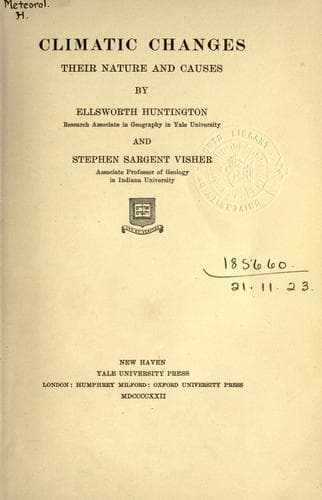
Climatic Changes: Their Nature and CausesHuntington, Ellsworth
Science
Climatic Changes: Their Nature and Causes
Huntington, Ellsworth
Climatic changes; Climatology; Paleoclimatology
One other possibility may be mentioned, although little stress should be
laid on it. In _Earth and Sun_ it has been shown that the main storm
track in both the northern and southern hemispheres is not concentric
with the geographical poles. Both tracks are roughly concentric with the
corresponding magnetic poles, a fact which may be important in
connection with the hypothesis of an electrical effect of the sun upon
terrestrial storminess. The magnetic poles are known to wander
considerably. Such wandering gives rise to variations in the direction
of the magnetic needle from year to year. In 1815 the compass in England
pointed 24-1/2 deg. W. of N. and in 1906 17 deg. 45' W. Such a variation seems
to mean a change of many miles in the location of the north magnetic
pole. Certain changes in the daily march of electromagnetic phenomena
over the oceans have led Bauer and his associates to suggest that the
magnetic poles may even be subject to a slight daily movement in
response to the changes in the relative positions of the earth and sun.
Thus there seems to be a possibility that a pronounced change in the
location of the magnetic pole in Permian times, for example, may have
had some connection with a shifting in the location of the belt of
storms. It must be clearly understood that there is as yet no evidence
of any such change, and the matter is introduced merely to call
attention to a possible line of investigation.
Any hypothesis of Permian and Proterozoic glaciation must explain not
only the glaciation of low latitudes but the lack of glaciation and the
accumulation of red desert beds in high latitudes. The facts already
presented seem to explain this. Glaciation could not occur extensively
in high latitudes partly because during most of the year the air was too
cold to hold much moisture, but still more because the winds for the
most part must have blown outward from the cold northern areas and the
cyclonic storm belt was pushed out of high latitudes. Because of these
conditions precipitation was apparently limited to a relatively small
number of storms during the summer. Hence great desert areas must have
prevailed at high latitudes. Great aridity now prevails north of the
Himalayas and related ranges, and red beds are accumulating in the
centers of the great deserts, such as those of the Tarim Basin and the
Transcaspian. The redness is not due to the original character of the
rock, but to intense oxidation, as appears from the fact that along the
edges of the desert and wherever occasional floods carry sediment far
out into the midst of the sand, the material has the ordinary brownish
shades. As soon as one goes out into the places where the sand has been
exposed to the air for a long time, however, it becomes pink, and then
red. Such conditions may have given rise to the high degree of oxidation
in the famous Permian red beds. If the air of the early Permian
contained an unusual percentage of oxygen because of the release of that
Public-domain text, read in full here on John Shaqi.
Reviews
Reviews
No reviews yet
Be the first to share your thoughts on this work.
Elsewhere in the archive
Join the Discussion
Join the discussion
Sign in to leave a comment or review.
Sign InorCreate an account