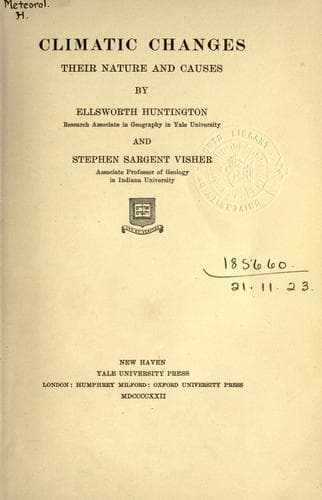
Climatic Changes: Their Nature and CausesHuntington, Ellsworth
Science
Climatic Changes: Their Nature and Causes
Huntington, Ellsworth
Climatic changes; Climatology; Paleoclimatology
It is now generally agreed that all typical loess is wind blown. There
is still much question, however, as to its time of origin, and thus
indirectly as to its climatic implications. Several American and
European students have thought that the loess dates from inter-glacial
times. On the other hand, Penck has concluded that the loess was formed
shortly before the commencement of the glacial epochs; while many
American geologists hold that the loess accumulated while the ice sheets
were at approximately their maximum size. W. J. McGee, Chamberlin and
Salisbury, Keyes, and others lean toward this view. In this chapter the
hypothesis is advanced that it was formed at the one other possible
time, namely, immediately following the retreat of the ice.
These four hypotheses as to the time of origin of loess imply the
following differences in its climatic relations. If loess was formed
during typical inter-glacial epochs, or toward the close of such epochs,
profound general aridity must seemingly have prevailed in order to kill
off the vegetation and thus enable the wind to pick up sufficient dust.
If the loess was formed during times of extreme glaciation when the
glaciers were supplying large quantities of fine material to outflowing
streams, less aridity would be required, but there must have been sharp
contrasts between wet seasons in summer when the snow was melting and
dry seasons in winter when the storms were forced far south by the
glacial high pressure. Alternate floods and droughts would thus affect
broad areas along the streams. Hence arises the hypothesis that the wind
obtained the loess from the flood plains of streams at times of maximum
glaciation. If the loess was formed during the rapid retreat of the ice,
alternate summer floods and winter droughts would still prevail, but
much material could also be obtained by the winds not only from flood
plains, but also from the deposits exposed by the melting of the ice and
not yet covered by vegetation.
The evidence for and against the several hypotheses may be stated
briefly. In support of the hypothesis of the inter-glacial origin of
loess, Shimek and others state that the glacial drift which lies beneath
the loess commonly gives evidence that some time elapsed between the
disappearance of the ice and the deposition of the loess. For example,
abundant shells of land snails in the loess are not of the sort now
found in colder regions, but resemble those found in the drier regions.
It is probable that if they represented a glacial epoch they would be
depauperated by the cold as are the snails of far northern regions. The
gravel pavement discussed below seems to be strong evidence of erosion
between the retreat of the ice and the deposition of the loess.
Public-domain text, read in full here on John Shaqi.
Reviews
Reviews
No reviews yet
Be the first to share your thoughts on this work.
Elsewhere in the archive
Join the Discussion
Join the discussion
Sign in to leave a comment or review.
Sign InorCreate an account