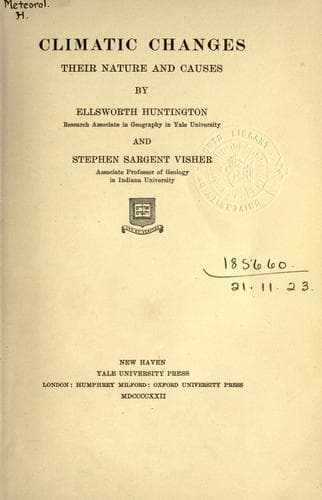
Climatic Changes: Their Nature and CausesHuntington, Ellsworth
Science
Climatic Changes: Their Nature and Causes
Huntington, Ellsworth
Climatic changes; Climatology; Paleoclimatology
Turning to the second hypothesis, namely, that the loess accumulated
near the close of the inter-glacial epoch rather than in the midst of
it, we may follow Penck. The mammalian fossils seem to him to prove that
the loess was formed while boreal animals occupied the region, for they
include remains of the hairy mammoth, woolly rhinoceros, and reindeer.
On the other hand, the typical inter-glacial beds not far away yield
remains of species characteristic of milder climates, such as the
elephant, the smaller rhinoceros, and the deer. In connection with these
facts it should be noted that occasional remains of tundra vegetation
and of trees are found beneath the loess, while in the loess itself
certain steppe animals, such as the common gopher or spermaphyl, are
found. Penck interprets this as indicating a progressive desiccation
culminating just before the oncoming of the next ice sheet.
The evidence advanced in favor of the hypothesis that the loess was
formed when glaciation was near its maximum includes the fact that if
the loess does not represent the outwash from the Iowan ice, there is
little else that does, and presumably there must have been outwash. Also
the distribution of loess along the margins of streams suggests that
much of the material came from the flood plains of overloaded streams
flowing from the melting ice.
Although there are some points in favor of the hypothesis that the loess
originated (1) in strictly inter-glacial times, (2) at the end of
inter-glacial epochs, and (3) at times of full glaciation, each
hypothesis is much weakened by evidence that supports the others. The
evidence of boreal animals seems to disprove the hypothesis that the
loess was formed in the middle of a mild inter-glacial epoch. On the
other hand, Penck's hypothesis as to loess at the end of inter-glacial
times fails to account for certain characteristics of the lowest part of
the loess deposits and of the underlying topography. Instead of normal
valleys and consequent prompt drainage such as ought to have developed
before the end of a long inter-glacial epoch, the surface on which the
loess lies shows many undrained depressions. Some of these can be seen
in exposed banks, while many more are inferred from the presence of
shells of pond snails here and there in the overlying loess. The pond
snails presumably lived in shallow pools occupying depressions in the
uneven surface left by the ice. Another reason for questioning whether
the loess was formed at the end of an inter-glacial epoch is that this
hypothesis does not provide a reasonable origin for the material which
composes the loess. Near the Alps where the loess deposits are small and
where glaciers probably persisted in the inter-glacial epochs and thus
supplied flood plain material in large quantities, this does not appear
important. In the broad upper Mississippi Basin, however, and also in
the Black Earth region of Russia there seems to be no way to get the
Public-domain text, read in full here on John Shaqi.
Reviews
Reviews
No reviews yet
Be the first to share your thoughts on this work.
Elsewhere in the archive
Join the Discussion
Join the discussion
Sign in to leave a comment or review.
Sign InorCreate an account