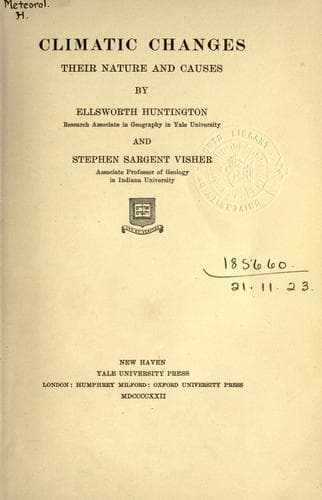
Climatic Changes: Their Nature and CausesHuntington, Ellsworth
Science
Climatic Changes: Their Nature and Causes
Huntington, Ellsworth
Climatic changes; Climatology; Paleoclimatology
through sand to coarse loess and then to normal fine loess. As the ice
sheet retreated the wind in any given place would gradually become less
violent. As the ice continued to retreat the area where loess was
deposited would follow at a distance, and thus each part of the gravel
pavement would in turn be covered with the loess.
The hypothesis that loess is deposited while the ice is retreating is in
accord with many other lines of evidence. For example, it accords with
the boreal character of the mammal remains as described above. Again,
the advance of vegetation into the barren zone along the front of the
ice would be delayed by the strong outblowing winds. The common pioneer
plants depend largely on the wind for the distribution of their seeds,
but the glacial winds would carry them away from the ice rather than
toward it. The glacial winds discourage the advance of vegetation in
another way, for they are drying winds, as are almost all winds blowing
from a colder to a warmer region. The fact that remains of trees
sometimes occur at the bottom of the loess probably means that the
deposition of loess extended into the forests which almost certainly
persisted not far from the ice. This seems more likely than that a
period of severe aridity before the advance of the ice killed the trees
and made a steppe or desert. Penck's chief argument in favor of the
formation of loess before the advance of the ice rather than after, is
that since loess is lacking upon the youngest drift sheet in Europe it
must have been formed before rather than after the last or Wuerm advance
of the ice. This breaks down on two counts. First, on the corresponding
(Wisconsin) drift sheet in America, loess is present,--in small
quantities to be sure, but unmistakably present. Second, there is no
reason to assume that conditions were identical at each advance and
retreat of the ice. Indeed, the fact that in Europe, as in the United
States, nearly all the loess was formed at one time, and only a little
is associated with the other ice advances, points clearly against
Penck's fundamental assumption that the accumulation of loess was due to
the approach of a cold climate.
Public-domain text, read in full here on John Shaqi.
Reviews
Reviews
No reviews yet
Be the first to share your thoughts on this work.
Elsewhere in the archive
Join the Discussion
Join the discussion
Sign in to leave a comment or review.
Sign InorCreate an account