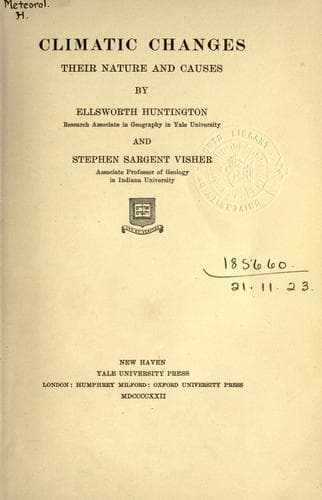
Climatic Changes: Their Nature and CausesHuntington, Ellsworth
Science
Climatic Changes: Their Nature and Causes
Huntington, Ellsworth
Climatic changes; Climatology; Paleoclimatology
We are now ready to consider the probability that loess accumulated
mainly during the retreat of the ice. Such a retreat exposed a zone of
drift to the outflowing glacial winds. Most glacial hypotheses, such as
that of uplift, or depleted carbon dioxide, call for a gradual retreat
of the ice scarcely faster than the vegetation could advance into the
abandoned area. Under the solar-cyclonic hypothesis, on the other hand,
the climatic changes may have been sudden and hence the retreat of the
ice may have been much more rapid than the advance of vegetation. Now
wind-blown materials are derived from places where vegetation is scanty.
Scanty vegetation on good soil, it is true, is usually due to aridity,
but may also result because the time since the soil was exposed to the
air has not been long enough for the soil to be sufficiently weathered
to support vegetation. Even when weathering has had full opportunity, as
when sand bars, mud flats, and flood plains are exposed, vegetation
takes root only slowly. Moreover, storms and violent winds may prevent
the spread of vegetation, as is seen on sandy beaches even in distinctly
humid regions like New Jersey and Denmark. Thus it appears that unless
the retreat of the ice were as slow as the advance of vegetation, a
barren area of more or less width must have bordered the retreating ice
and formed an ideal source of loess.
Several other lines of evidence seemingly support the conclusion that
the loess was formed during the retreat of the ice. For example, Shimek,
who has made almost a lifelong study of the Iowan loess, emphasizes the
fact that there is often an accumulation of stones and pebbles at its
base. This suggests that the underlying till was eroded before the loess
was deposited upon it. The first reaction of most students is to assume
that of course this was due to running water. That is possible in many
cases, but by no means in all. So widespread a sheet of gravel could not
be deposited by streams without destroying the irregular basins and
hollows of which we have seen evidence where the loess lies on glacial
deposits. On the other hand, the wind is competent to produce a similar
gravel pavement without disturbing the old topography. "Desert
pavements" are a notable feature in most deserts. On the edges of an ice
sheet, as Hobbs has made us realize, the commonest winds are outward.
They often attain a velocity of eighty miles an hour in Antarctica and
Greenland. Such winds, however, usually decline rapidly in velocity only
a few score miles from the ice. Thus their effect would be to produce
rapid erosion of the freshly bared surface near the retreating ice. The
pebbles would be left behind as a pavement, while sand and then loess
would be deposited farther from the ice where the winds were weaker and
where vegetation was beginning to take root. Such a decrease in wind
velocity may explain the occasional vertical gradation from gravel
Public-domain text, read in full here on John Shaqi.
Reviews
Reviews
No reviews yet
Be the first to share your thoughts on this work.
Elsewhere in the archive
Join the Discussion
Join the discussion
Sign in to leave a comment or review.
Sign InorCreate an account