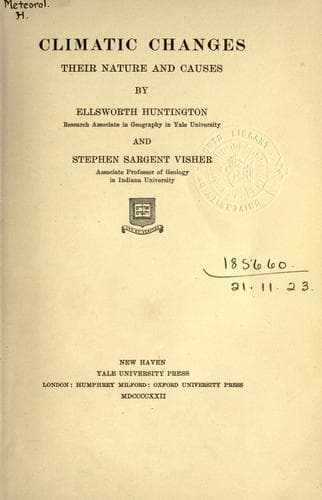
Climatic Changes: Their Nature and CausesHuntington, Ellsworth
Science
Climatic Changes: Their Nature and Causes
Huntington, Ellsworth
Climatic changes; Climatology; Paleoclimatology
In discussions of climate, as of most subjects, a peculiar psychological
phenomenon is observable. Everyone sees the necessity of explaining
conditions different from those that now exist, but few realize that
present conditions may be abnormal, and that they need explanation just
as much as do others. Because of this tendency glaciation has been
discussed with the greatest fullness, while there has been much neglect
not only of the periods when the climate of the earth resembled that of
the present, but also of the vastly longer periods when it was even
milder than now.
How important the periods of mild climate have been in geological times
may be judged from the relative length of glacial compared with
inter-glacial epochs, and still more from the far greater relative
length of the mild parts of periods and eras when compared with the
severe parts. Recent estimates by R. T. Chamberlin[58] indicate that
according to the consensus of opinion among geologists the average
inter-glacial epoch during the Pleistocene was about five times as long
as the average glacial epoch, while the whole of a given glacial epoch
averaged five times as long as the period when the ice was at a maximum.
Climatic periods far milder, longer, and more monotonous than any
inter-glacial epoch appear repeatedly during the course of geological
history. Our task in this chapter is to explain them.
Knowlton[59] has done geology a great service by collecting the evidence
as to the mild type of climate which has again and again prevailed in
the past. He lays special stress on botanical evidence since that
pertains to the variable atmosphere of the lands, and hence furnishes a
better guide than does the evidence of animals that lived in the
relatively unchanging water of the oceans. The nature of the evidence
has already been indicated in various parts of this book. It includes
palms, tree ferns, and a host of other plants which once grew in regions
which are now much too cold to support them. With this must be placed
the abundant reef-building corals and other warmth-loving marine
creatures in latitudes now much too cold for them. Of a piece with this
are the conditions of inter-glacial epochs in Europe, for example, when
elephants and hippopotamuses, as well as many species of plants from low
latitudes, were abundant. These conditions indicate not only that the
climate was warmer than now, but that the contrast from season to season
was much less. Indeed, Knowlton goes so far as to say that "relative
uniformity, mildness, and comparative equability of climate, accompanied
by high humidity, have prevailed over the greater part of the earth,
extending to, or into, polar circles, during the greater part of
geologic time--since, at least, the Middle Paleozoic. This is the
regular, the ordinary, the normal condition." ... "By many it is thought
that one of the strongest arguments against a gradually cooling globe
and a humid, non-zonally disposed climate in the ages before the
Public-domain text, read in full here on John Shaqi.
Reviews
Reviews
No reviews yet
Be the first to share your thoughts on this work.
Elsewhere in the archive
Join the Discussion
Join the discussion
Sign in to leave a comment or review.
Sign InorCreate an account