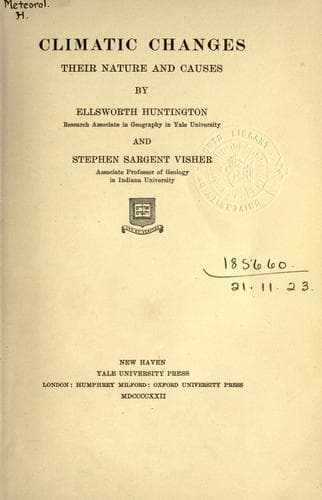
Climatic Changes: Their Nature and CausesHuntington, Ellsworth
Science
Climatic Changes: Their Nature and Causes
Huntington, Ellsworth
Climatic changes; Climatology; Paleoclimatology
Pleistocene is the discovery of evidences of glacial action practically
throughout the entire geologic column. Hardly less than a dozen of these
are now known, ranging in age from Huronian to Eocene. It seems to be a
very general assumption by those who hold this view that these evidences
of glacial activities are to be classed as ice ages, largely comparable
in effect and extent to the Pleistocene refrigeration, but as a matter
of fact only three are apparently of a magnitude to warrant such
designation. These are the Huronian glaciation, that of the
'Permo-Carboniferous,' and that of the Pleistocene. The others, so far
as available data go, appear to be explainable as more or less local
manifestations that had no widespread effect on, for instance, ocean
temperatures, distribution of life, et cetera. They might well have been
of the type of ordinary mountain glaciers, due entirely to local
elevation and precipitation." ... "If the sun had been the principal
source of heat in pre-Pleistocene time, terrestrial temperatures would
of necessity have been disposed in zones, whereas the whole trend of
this paper has been the presentation of proof that these temperatures
were distinctly non-zonal. Therefore it seems to follow that the sun--at
least the present small-angle sun--could not have been the sole or even
the principal source of heat that warmed the early oceans."
Knowlton is so strongly impressed by the widespread fossil floras that
usually occur in the middle parts of the geological periods, that as
Schuchert[3] puts it, he neglects the evidence of other kinds. In the
middle of the periods and eras the expansion of the warm oceans over the
continents was greatest, while the lands were small and hence had more
or less insular climates of the oceanic type. At such times, the marine
fauna agrees with the flora in indicating a mild climate. Large
colony-forming foraminifera, stony corals, shelled cephalopods,
gastropods and thick-shelled bivalves, generally the cemented forms,
were common in the Far North and even in the Arctic. This occurred in
the Silurian, Devonian, Pennsylvanian, and Jurassic periods, yet at
other times, such as the Cretaceous and Eocene, such forms were very
greatly reduced in variety in the northern regions or else wholly
absent. These things, as Schuchert[60] says, can only mean that Knowlton
is right when he states that "climatic zoning such as we have had since
the beginning of the Pleistocene did not obtain in the geologic ages
prior to the Pleistocene." It does not mean, however, that there was a
"non-zonal arrangement" and that the temperature of the oceans was
everywhere the same and "without widespread effect on the distribution
of life."
Public-domain text, read in full here on John Shaqi.
Reviews
Reviews
No reviews yet
Be the first to share your thoughts on this work.
Elsewhere in the archive
Join the Discussion
Join the discussion
Sign in to leave a comment or review.
Sign InorCreate an account