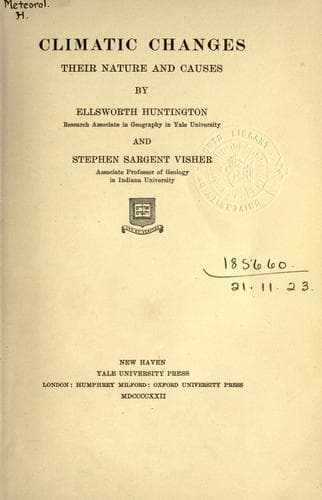
Climatic Changes: Their Nature and CausesHuntington, Ellsworth
Science
Climatic Changes: Their Nature and Causes
Huntington, Ellsworth
Climatic changes; Climatology; Paleoclimatology
In this connection a suggestion which is elaborated in Chapter XIII may
be mentioned. At present the salinity of the oceans checks the general
deep-sea circulation and thereby increases the contrasts from zone to
zone. In the past, however, the ocean must have been fresher than now.
Hence the circulation was presumably less impeded, and the transfer of
heat from low latitudes to high was facilitated.
Consider now the magnitude of the probable effect of a diminution in
storms. Today off the coast of Norway in latitude 65 deg.N. and longitude
10 deg.E., the mean temperature in January is 2 deg.C. and in July 12 deg.C. This
represents a plus anomaly of about 22 deg. in January and 2 deg. in July; that
is, the Norwegian coast is warmer than the normal for its latitude by
these amounts. Suppose that in some past time the present distribution
of lands and seas prevailed, but Norway was a lowland where extensive
deposits could accumulate in great flood plains. Suppose, also, that the
sun's atmosphere was so inactive that few cyclonic storms occurred,
steady winds from the west-southwest prevailed, and strong,
uninterrupted ocean currents brought from the Caribbean Sea and Gulf of
Mexico much greater supplies of warm water than at present. The
Norwegian winters would then be warmer than now not only because of the
general increase in temperature which the earth regularly experiences at
sunspot minima, but because the currents would accentuate this
condition. In summer similar conditions would prevail except that the
warming effect of the winds and currents would presumably be less than
in winter, but this might be more than balanced by the increased heat of
the sun during the long summer days, for storms and clouds would be
rare.
If such conditions raised the winter temperature only 8 deg.C. and the
summer temperature 4 deg.C., the climate would be as warm as that of the
northern island of New Zealand (latitude 35 deg.-43 deg.S.). The flora of that
part of New Zealand is subtropical and includes not only pines and
beeches, but palms and tree ferns. A climate scarcely warmer than that
of New Zealand would foster a flora like that which existed in far
northern latitudes during some of the milder geological periods. If,
however, the general temperature of the earth's surface were raised 5 deg.
because of the scarcity of storms, if the currents were strong enough so
that they increased the present anomaly by 50 per cent, and if more
persistent sunshine in summer raised the temperature at that season
about 4 deg.C., the January temperature would be 18 deg.C. and the July
temperature 22 deg.C. These figures perhaps make summer and winter more
nearly alike than was ever really the case in such latitudes.
Nevertheless, they show that a diminution of storms and a consequent
strengthening and steadying of the southwesterlies might easily raise
the temperature of the Norwegian coast so high that corals could
flourish within the Arctic Circle.
Public-domain text, read in full here on John Shaqi.
Reviews
Reviews
No reviews yet
Be the first to share your thoughts on this work.
Elsewhere in the archive
Join the Discussion
Join the discussion
Sign in to leave a comment or review.
Sign InorCreate an account