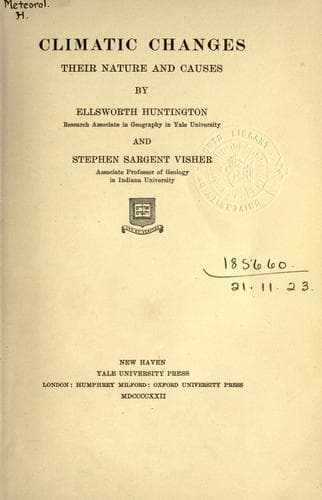
Climatic Changes: Their Nature and CausesHuntington, Ellsworth
Science
Climatic Changes: Their Nature and Causes
Huntington, Ellsworth
Climatic changes; Climatology; Paleoclimatology
The temperature of the ocean depths cannot permanently remain lower than
that of the coldest parts of the surface. Temporarily this might indeed
happen when a solar change first reduced the storminess and strengthened
the westerlies and the surface currents. Gradually, however, the
persistent deep-sea circulation would bring up the colder water in low
latitudes and carry downward the water of medium temperature at the
coldest part of the surface. Thus in time the whole body of the ocean
would become warm. The heat which at present is carried away from the
earth's surface in storms would slowly accumulate in the oceans. As the
process went on, all parts of the ocean's surface would become warmer,
for equatorial latitudes would be less and less cooled by cold water
from below, while the water blown from low latitudes to high would be
correspondingly warmer. The warming of the ocean would come to an end
only with the attainment of a state of equilibrium in which the loss of
heat by radiation and evaporation from the ocean's surface equaled the
loss which under other circumstances would arise from the rise of warm
air in cyclonic storms. When once the oceans were warmed, they would
form an extremely strong conservative force tending to preserve an
equable climate in all latitudes and at all seasons. According to the
solar cyclonic hypothesis such conditions ought to have prevailed
throughout most of geological time. Only after a strong and prolonged
solar disturbance with its consequent storminess would conditions like
those of today be expected.
In this connection another possibility may be mentioned. It is commonly
assumed that the earth's axis is held steadily in one direction by the
fact that the rotating earth is a great gyroscope. Having been tilted to
a certain position, perhaps by some extraneous force, the axis is
supposed to maintain that position until some other force intervenes.
Cordeiro,[67] however, maintains that this is true only of an absolutely
rigid gyroscope. He believes that it is mathematically demonstrable that
if an elastic gyroscope be gradually tilted by some extraneous force,
and if that force then ceases to act, the gyroscope as a whole will
oscillate back and forth. The earth appears to be slightly elastic.
Cordeiro therefore applies his formulae to it, on the following
assumptions: (1) That the original position of the axis was nearly
vertical to the plane of the ecliptic in which the earth revolves around
the sun; (2) that at certain times the inclination has been even greater
than now; and (3) that the position of the axis with reference to the
earth has not changed to any great extent, that is, the earth's poles
have remained essentially stationary with reference to the earth,
although the whole earth has been gyroscopically tilted back and forth
repeatedly.
Public-domain text, read in full here on John Shaqi.
Reviews
Reviews
No reviews yet
Be the first to share your thoughts on this work.
Elsewhere in the archive
Join the Discussion
Join the discussion
Sign in to leave a comment or review.
Sign InorCreate an account