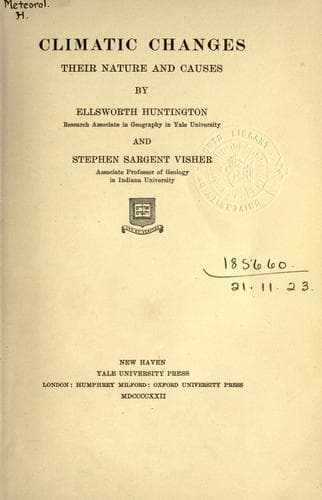
Climatic Changes: Their Nature and CausesHuntington, Ellsworth
Science
Climatic Changes: Their Nature and Causes
Huntington, Ellsworth
Climatic changes; Climatology; Paleoclimatology
The strong steady trades and southwesterlies which would prevail at
times of slight solar activity, according to our hypothesis, would have
a pronounced effect on the water of the deep seas as well as upon that
of the surface. In the first place, the deep-sea circulation would be
hastened. For convenience let us speak of the northern hemisphere. In
the past, whenever the southwesterly winds were steadier than now, as
was probably the case when cyclonic storms were relatively rare, more
surface water than at present was presumably driven from low latitudes
and carried to high latitudes. This, of course, means that a greater
volume of water had to flow back toward the equator in the lower parts
of the ocean, or else as a cool surface current. The steady
southwesterly winds, however, would interfere with south-flowing surface
currents, thus compelling the polar waters to find their way equatorward
beneath the surface. In low latitudes the polar waters would rise and
their tendency would be to lower the temperature. Hence steadier
westerlies would make for lessened latitudinal contrasts in climate not
only by driving more warm water poleward but by causing more polar water
to reach low latitudes.
At this point a second important consideration must be faced. Not only
would the deep-sea circulation be hastened, but the ocean depths might
be warmed. The deep parts of the ocean are today cold because they
receive their water from high latitudes where it sinks because of low
temperature. Suppose, however, that a diminution in storminess combined
with other conditions should permit corals to grow in latitude 70 deg.N. The
ocean temperature would then have to average scarcely lower than 20 deg.C.
and even in the coldest month the water could scarcely fall below about
15 deg.C. Under such conditions, if the polar ocean were freely connected
with the rest of the oceans, no part of it would probably have a
temperature much below 10 deg.C., for there would be no such thing as ice
caps and snowfields to reflect the scanty sunlight and radiate into
space what little heat there was. On the contrary, during the winter an
almost constant state of dense fogginess would prevail. So great would
be the blanketing effect of this that a minimum monthly temperature of
10 deg.C. for the coldest part of the ocean may perhaps be too low for a
time when corals thrived in latitude 70 deg..
Public-domain text, read in full here on John Shaqi.
Reviews
Reviews
No reviews yet
Be the first to share your thoughts on this work.
Elsewhere in the archive
Join the Discussion
Join the discussion
Sign in to leave a comment or review.
Sign InorCreate an account