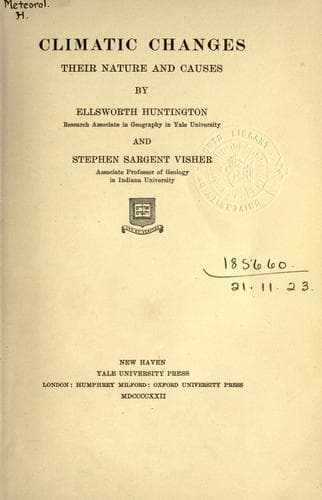
Climatic Changes: Their Nature and CausesHuntington, Ellsworth
Science
Climatic Changes: Their Nature and Causes
Huntington, Ellsworth
Climatic changes; Climatology; Paleoclimatology
Without expressing any opinion as to the value of Cordeiro's results we
feel that the subject of the earth's gyroscopic motion and of a possible
secular change in the direction of the axis deserves investigation for
two chief reasons. In the first place, evidences of seasonal changes and
of seasonal uniformity seem to occur more or less alternately in the
geological record. Second, the remarkable discoveries of Garner and
Allard[68] show that the duration of daylight has a pronounced effect
upon the reproduction of plants. We have referred repeatedly to the tree
ferns, corals, and other forms of life which now live in relatively low
latitudes and which cannot endure strong seasonal contrasts, but which
once lived far to the north. On the other hand, Sayles,[69] for example,
finds that microscopical examination of the banding of ancient shales
and slates indicates distinct seasonal banding like that of recent
Pleistocene clays or of the Squantum slate formed during or near the
Permian glacial period. Such seasonal banding is found in rocks of
various ages: (a) Huronian, in cobalt shales previously reported by
Coleman; (b) late Proterozoic or early Cambrian in Hiwassee slate; (c)
lower Cambrian, in Georgian slates of Vermont; (d) lower Ordovician, in
Georgia (Rockmart slate), Tennessee (Athens shale), Vermont (slates),
and Quebec (Beekmantown formation); and (e) Permian in Massachusetts
(Squantum slate). How far the periods during which such evidence of
seasons was recorded really alternated with mild periods, when tropical
species lived in high latitudes and the contrast of seasons was almost
or wholly lacking, we have as yet no means of knowing. If periods
characterized by marked seasonal changes should be found to have
alternated with those when the seasons were of little importance, the
fact would be of great geological significance.
Public-domain text, read in full here on John Shaqi.
Reviews
Reviews
No reviews yet
Be the first to share your thoughts on this work.
Elsewhere in the archive
Join the Discussion
Join the discussion
Sign in to leave a comment or review.
Sign InorCreate an account