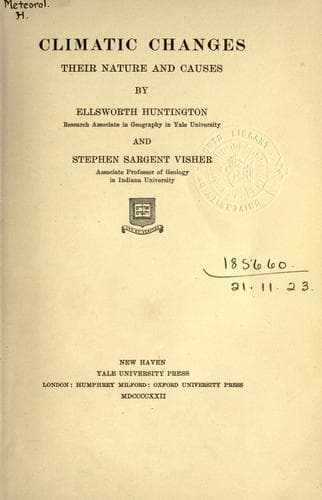
Climatic Changes: Their Nature and CausesHuntington, Ellsworth
Science
Climatic Changes: Their Nature and Causes
Huntington, Ellsworth
Climatic changes; Climatology; Paleoclimatology
The discoveries of Garner and Allard as to the effect of light on
reproduction began with a peculiar tobacco plant which appeared in some
experiments at Washington. The plant grew to unusual size, and seemed to
promise a valuable new variety. It formed no seeds, however, before the
approach of cold weather. It was therefore removed to a greenhouse where
it flowered and produced seed. In succeeding years the flowering was
likewise delayed till early winter, but finally it was discovered that
if small plants were started in the greenhouse in the early fall they
flowered at the same time as the large ones. Experiments soon
demonstrated that the time of flowering depends largely upon the length
of the daily period when the plants are exposed to light. The same is
true of many other plants, and there is great variety in the conditions
which lead to flowering. Some plants, such as witch hazel, appear to be
stimulated to bloom by very short days, while others, such as evening
primrose, appear to require relatively long days. So sensitive are
plants in this respect that Garner and Allard, by changing the length of
the period of light, have caused a flowerbud in its early stages not
only to stop developing but to return once more to a vegetative shoot.
Common iris, which flowers in May and June, will not blossom under
ordinary conditions when grown in the greenhouse in winter, even
under the same temperature conditions that prevail in early summer.
Again, one variety of soy beans will regularly begin to flower in
June of each year, a second variety in July, and a third in August,
when all are planted on the same date. There are no temperature
differences during the summer months which could explain these
differences in time of flowering; and, since "internal causes" alone
cannot be accepted as furnishing a satisfactory explanation, some
external factor other than temperature must be responsible.
The ordinary varieties of cosmos regularly flower in the fall in
northern latitudes if they are planted in the spring or summer. If
grown in a warm greenhouse during the winter months the plants also
flower readily, so that the cooler weather of fall is not a
necessary condition. If successive plantings of cosmos are made in
the greenhouse during the late winter and early spring months,
maintaining a uniform temperature throughout, the plantings made
after a certain date will fail to blossom promptly, but, on the
contrary, will continue to grow till the following fall, thus
flowering at the usual season for this species. This curious
reversal of behavior with advance of the season cannot be attributed
to change in temperature. Some other factor is responsible for the
failure of cosmos to blossom during the summer months. In this
respect the behavior of cosmos is just the opposite of that observed
in iris.
Public-domain text, read in full here on John Shaqi.
Reviews
Reviews
No reviews yet
Be the first to share your thoughts on this work.
Elsewhere in the archive
Join the Discussion
Join the discussion
Sign in to leave a comment or review.
Sign InorCreate an account