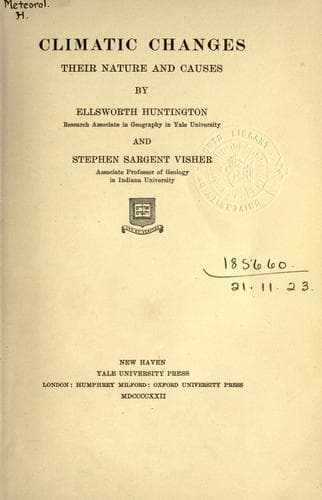
Climatic Changes: Their Nature and CausesHuntington, Ellsworth
Science
Climatic Changes: Their Nature and Causes
Huntington, Ellsworth
Climatic changes; Climatology; Paleoclimatology
The major portion of this book has been concerned with the explanation
of the more abrupt and extreme changes of climate. This chapter and the
next consider two other sorts of climatic changes, the slight secular
progression during the hundreds of millions of years of recorded earth
history, and especially the long slow geologic oscillations of millions
or tens of millions of years. It is generally agreed among geologists
that the progressive change has tended toward greater extremes of
climate; that is, greater seasonal contrasts, and greater contrasts from
place to place and from zone to zone.[70] The slow cyclic changes have
been those that favored widespread glaciation at one extreme near the
ends of geologic periods and eras, and mild temperatures even in
subpolar regions at the other extreme during the medial portions of the
periods.
As has been pointed out in an earlier chapter, it has often been assumed
that all climatic changes are due to terrestrial causes. We have seen,
however, that there is strong evidence that solar variations play a
large part in modifying the earth's climate. We have also seen that no
known terrestrial agency appears to be able to produce the abrupt
changes noted in recent years, the longer cycles of historical times, or
geological changes of the shorter type, such as glaciation.
Nevertheless, terrestrial changes doubtless have assisted in producing
both the progressive change and the slow cyclic changes recorded in the
rocks, and it is the purpose of this chapter and the two that follow to
consider what terrestrial changes have taken place and the probable
effect of such changes.
The terrestrial changes that have a climatic significance are numerous.
Some, such as variations in the amount of volcanic dust in the higher
air, have been considered in an earlier chapter. Others are too
imperfectly known to warrant discussion, and in addition there are
presumably others which are entirely unknown. Doubtless some of these
little known or unknown changes have been of importance in modifying
climate. For example, the climatic influence of vegetation, animals, and
man may be appreciable. Here, however, we shall confine ourselves to
purely physical causes, which will be treated in the following order:
First, those concerned with the solid parts of the earth, namely: (I)
amount of land; (II) distribution of land; (III) height of land; (IV)
lava flows; and (V) internal heat. Second, those which arise from the
salinity of oceans, and third, those depending on the composition and
amount of atmosphere.
Public-domain text, read in full here on John Shaqi.
Reviews
Reviews
No reviews yet
Be the first to share your thoughts on this work.
Elsewhere in the archive
Join the Discussion
Join the discussion
Sign in to leave a comment or review.
Sign InorCreate an account