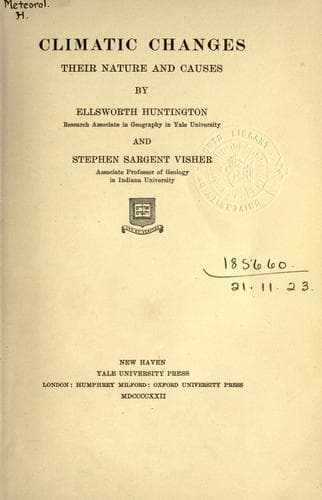
Climatic Changes: Their Nature and CausesHuntington, Ellsworth
Science
Climatic Changes: Their Nature and Causes
Huntington, Ellsworth
Climatic changes; Climatology; Paleoclimatology
Many important biological consequences might be drawn from this study of
mild geological climates, but this book is not the place for them. In
the first chapter we saw that one of the most remarkable features of the
climate of the earth is its wonderful uniformity through hundreds of
millions of years. As we come down through the vista of years the mild
geological periods appear to represent a return as nearly as possible to
this standard condition of uniformity. Certain changes of the earth
itself, as we shall see in the next chapter, may in the long run tend
slightly to change the exact conditions of this climatic standard, as we
might perhaps call it. Yet they act so slowly that their effect during
hundreds of millions of years is still open to question. At most they
seem merely to have produced a slight increase in diversity from season
to season and from zone to zone. The normal climate appears still to be
of a milder type than that which happens to prevail at present. Some
solar condition, whose possible nature will be discussed later, seems
even now to cause the number of cyclonic storms to be greater than
normal. Hence the earth's climate still shows something of the great
diversity of seasons and of zones which is so marked a characteristic of
glacial epochs.
FOOTNOTES:
[Footnote 58: Rollin T. Chamberlin: Personal Communication.]
[Footnote 59: F. H. Knowlton: Evolution of Geologic Climates; Bull.
Geol. Soc. Am., Vol. 30, 1919, pp. 499-566.]
[Footnote 60: Chas. Schuchert: Review of Knowlton's Evolution of
Geological Climates, in Am. Jour. Sci., 1921.]
[Footnote 61: G. R. Wieland: Distribution and Relationships of the
Cycadeoids; Am. Jour. Bot., Vol. 7, 1920, pp. 125-145.]
[Footnote 62: D. T. MacDougal: Botanical Features of North American
Deserts; Carnegie Instit. of Wash., No. 99, 1908.]
[Footnote 63: _Loc. cit._]
[Footnote 64: H. H. Clayton: Variation in Solar Radiation and the
Weather; Smiths. Misc. Coll., Vol. 71, No. 3, Washington, 1920.]
[Footnote 65: B. Helland Hansen and F. Nansen: Temperature Variations in
the North Atlantic Ocean and in the Atmosphere; Misc. Coll., Smiths.
Inst., Vol. 70, No. 4, Washington, 1920.]
[Footnote 66: The climatic significance of ocean currents is well
discussed in Croll's Climate and Time, 1875, and his Climate and
Cosmogony, 1889.]
[Footnote 67: F. J. B. Cordeiro: The Gyroscope, 1913.]
[Footnote 68: W. W. Garner and H. A. Allard: Flowering and Fruition of
Plants as Controlled by Length of Day; Yearbook Dept. Agri., 1920, pp.
377-400.]
[Footnote 69: Report of Committee on Sedimentation, National Research
Council, April, 1922.]
CHAPTER XI
TERRESTRIAL CAUSES OF CLIMATIC CHANGES
Public-domain text, read in full here on John Shaqi.
Reviews
Reviews
No reviews yet
Be the first to share your thoughts on this work.
Elsewhere in the archive
Join the Discussion
Join the discussion
Sign in to leave a comment or review.
Sign InorCreate an account