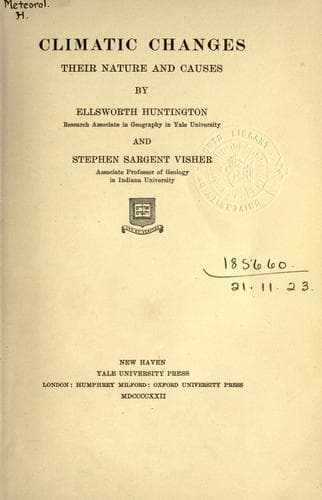
Climatic Changes: Their Nature and CausesHuntington, Ellsworth
Science
Climatic Changes: Their Nature and Causes
Huntington, Ellsworth
Climatic changes; Climatology; Paleoclimatology
According to a well-established law of physics, contraction of a
rotating body results in more rapid rotation and greater centrifugal
force. These conditions must increase the earth's equatorial bulge and
thereby cause changes in the distribution of land and water. Opposed to
the rearrangement of the land due to increased rotation caused by
contraction, there has presumably been another rearrangement due to
tidal retardation of the earth's rotation and a consequent lessening of
the equatorial bulge. G. H. Darwin long ago deduced a relatively large
retardation due to lunar tides. A few years ago W. D. MacMillan, on
other assumptions, deduced only a negligible retardation. Still more
recently Taylor[73] has studied the tides of the Irish Sea, and his work
has led Jeffreys[74] and Brown[75] to conclude that there has been
considerable retardation, perhaps enough, according to Brown, to equal
the acceleration due to the earth's contraction. From a prolonged and
exhaustive study of the motions of the moon Brown concludes that tidal
friction or some other cause is now lengthening the day at the rate of
one second per thousand years, or an hour in almost four million years
if the present rate continues. He makes it clear that the retardation
due to tides would not correspond in point of time with the acceleration
due to contraction. The retardation would occur slowly, and would take
place chiefly during the long quiet periods of geologic history, while
the acceleration would occur rapidly at times of diastrophic
deformation. As a consequence, the equatorial bulge would alternately be
reduced at a slow rate, and then somewhat suddenly augmented.
The less rigid any part of the earth is, the more quickly it responds to
the forces which lead to bulging or which tend to lessen the bulge.
Since water is more fluid than land, the contraction of the earth and
the tidal retardation presumably tend alternately to increase and
decrease the amount of water near the equator more than the amount of
land. Thus, throughout geological history we should look for cyclic
changes in the relative area of the lands within the tropics and similar
changes of opposite phase in higher latitudes. The extent of the change
would depend upon (a) the amount of alteration in the speed of rotation,
and (b) the extent of low land in low latitudes and of shallow sea in
high latitudes. According to Slichter's tables, if the earth should
rotate in twenty-three hours instead of twenty-four, the great Amazon
lowland would be submerged by the inflow of oceanic water, while wide
areas in Hudson Bay, the North Sea, and other northern regions, would
become land because the ocean water would flow away from them.[76]
Public-domain text, read in full here on John Shaqi.
Reviews
Reviews
No reviews yet
Be the first to share your thoughts on this work.
Elsewhere in the archive
Join the Discussion
Join the discussion
Sign in to leave a comment or review.
Sign InorCreate an account