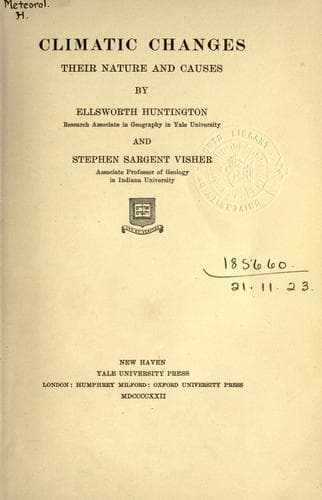
Climatic Changes: Their Nature and CausesHuntington, Ellsworth
Science
Climatic Changes: Their Nature and Causes
Huntington, Ellsworth
Climatic changes; Climatology; Paleoclimatology
Following the prompt equatorward movement of water which would occur as
the speed of rotation increased, there must also be a gradual movement
or creepage of the solid rocks toward the equator, that is, a bulging of
the ocean floor and of the lands in low latitudes, with a consequent
emergence of the lands there and a relative rise of sea level in higher
latitudes. Tidal retardation would have a similar effect. Suess[77] has
described widespread elevated strand lines in the tropics which he
interprets as indicating a relatively sudden change in sea level, though
he does not suggest a cause of the change. However, in speaking of
recent geological times, Suess reports that a movement more recent than
the old strands "was an accumulation of water toward the equator, a
diminution toward the poles, and (it appears) as though this last
movement were only one of the many oscillations which succeed each other
with the same tendency, i.e., with a positive excess at the equator, a
negative excess at the poles." (Vol. II, p. 551.) This creepage of the
rocks equatorward seemingly might favor the growth of mountains in
tropical and subtropical regions, because it is highly improbable that
the increase in the bulge would go on in all longitudes with perfect
uniformity. Where it went on most rapidly mountains would arise. That
such irregularity of movement has actually occurred is suggested not
only by the fact that many Cenozoic and older mountain ranges extend
east and west, but by the further fact that these include some of our
greatest ranges, many of which are in fairly low latitudes. The
Himalayas, the Javanese ranges, and the half-submerged Caribbean chains
are examples. Such mountains suggest a thrust in a north and south
direction which is just what would happen if the solid mass of the earth
were creeping first equatorward and then poleward.
A fact which is in accord with the idea of a periodic increase in the
oceans in low latitudes because of renewed bulging at the equator is the
exposure in moderately high latitudes of the greatest extent of ancient
rocks. This seems to mean that in low latitudes the frequent deepening
of the oceans has caused the old rocks to be largely covered by
sediments, while the old lands in higher latitudes have been left more
fully exposed to erosion.
Public-domain text, read in full here on John Shaqi.
Reviews
Reviews
No reviews yet
Be the first to share your thoughts on this work.
Elsewhere in the archive
Join the Discussion
Join the discussion
Sign in to leave a comment or review.
Sign InorCreate an account