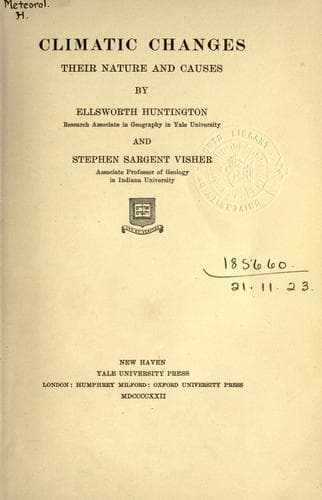
Climatic Changes: Their Nature and CausesHuntington, Ellsworth
Science
Climatic Changes: Their Nature and Causes
Huntington, Ellsworth
Climatic changes; Climatology; Paleoclimatology
An increase in the lands would cause changes in several climatic
conditions. (a) The range of temperature between day and night and
between summer and winter would increase, for lands become warmer by day
and in summer than do oceans, and cooler at night and in winter. The
higher summer temperature when the lands are widespread is due chiefly
to the fact that the land, if not snow-covered, absorbs more of the
sun's radiant energy than does the ocean, for its reflecting power is
low. The lower winter temperature when lands are widespread occurs not
only because they cool off rapidly but because the reduced oceans cannot
give them so much heat. Moreover, the larger the land, the more
generally do the winds blow outward from it in winter and thus prevent
the ocean heat from being carried inland. So long as the ocean is not
frozen in high latitudes, it is generally the chief source of heat in
winter, for the nights are several months long near the poles, and even
when the sun does shine its angle is so low that reflection from the
snow is very great. Furthermore, although on the average there is more
reflection from water than from land, the opposite is true in high
latitudes in winter when the land is snow-covered while the ocean is
relatively dark and is roughened by the waves. Another factor in causing
large lands to have extremely low temperature in winter is the fact that
in proportion to their size they are less protected by fog and cloud
than are smaller areas. The belt of cloud and fog which is usually
formed when the wind blows from the ocean to the relatively cold land is
restricted to the coastal zone. Thus the larger the land, the smaller
the fraction in which loss of heat by radiation is reduced by clouds and
fogs. Hence an increase in the land area is accompanied by an increase
in the contrasts in temperature between land and water.
(b) The contrasts in temperature thus produced must cause similar
contrasts in atmospheric pressure, and hence stronger barometric
gradients. (c) The strong gradients would mean strong winds, flowing
from land to sea or from sea to land. (d) Local convection would also be
strengthened in harmony with the expansion of the lands, for the more
rapid heating of land than of water favors active convection.
Public-domain text, read in full here on John Shaqi.
Reviews
Reviews
No reviews yet
Be the first to share your thoughts on this work.
Elsewhere in the archive
Join the Discussion
Join the discussion
Sign in to leave a comment or review.
Sign InorCreate an account