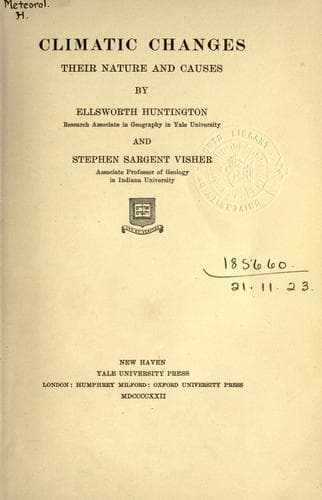
Climatic Changes: Their Nature and CausesHuntington, Ellsworth
Science
Climatic Changes: Their Nature and Causes
Huntington, Ellsworth
Climatic changes; Climatology; Paleoclimatology
Although the processes which cause contraction probably go on steadily,
their effect, as Chamberlin[81] and others have pointed out, is probably
delayed by inertia. Thus the settling of the crust or its movement on a
large scale is delayed. Perhaps the delay continues until the stresses
become so great that of themselves they overcome the inertia, or
possibly some outside agency, whose nature we shall consider later,
reenforces the stresses and gives the slight impulse which is enough to
release them and allow the earth's crust to settle into a new state of
equilibrium. When contraction proceeds actively, the ocean segments,
being largest and heaviest, are likely to settle most, resulting in a
deepening of the oceans and an emergence of the lands. Following each
considerable contraction there would be an increase in the speed of
rotation. The repeated contractions with consequent growth of the
equatorial bulge would alternate with long quiet periods during which
tidal retardation would again decrease the speed of rotation and hence
lessen the bulge. The result would be repeated changes of distribution
of land and water, with consequent changes in climate.
I. We shall now consider the climatic effect of the repeated changes in
the relative amounts of land and water which appear to have resulted
from the earth's contraction and from changes in its speed of rotation.
During many geologic epochs a larger portion of the earth was covered
with water than at present. For example, during at least twelve out of
about twenty epochs, North America has suffered extensive
inundations,[82] and in general the extensive submergence of Europe, the
other area well known geologically, has coincided with that of North
America. At other times, the ocean has been less extensive than now, as
for example during the recent glacial period, and probably during
several of the glacial periods of earlier date. Each of the numerous
changes in the relative extent of the lands must have resulted in a
modification of climate.[83] This modification would occur chiefly
because water becomes warm far more slowly than land, and cools off far
more slowly.
Public-domain text, read in full here on John Shaqi.
Reviews
Reviews
No reviews yet
Be the first to share your thoughts on this work.
Elsewhere in the archive
Join the Discussion
Join the discussion
Sign in to leave a comment or review.
Sign InorCreate an account