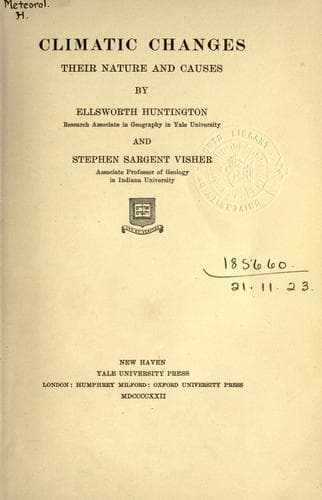
Climatic Changes: Their Nature and CausesHuntington, Ellsworth
Science
Climatic Changes: Their Nature and Causes
Huntington, Ellsworth
Climatic changes; Climatology; Paleoclimatology
(c) There is evidence that during geologic history the area of the lands
in middle and high latitudes, as well as in low latitudes, has changed
radically. An increase in such lands would cause the winters to grow
colder. This would be partly because of the loss of heat by radiation
into the cold dry air over the continents in winter, and partly because
of increased reflection from snow and frost, which gather much more
widely upon the land than upon the ocean. Furthermore, in winter when
the continents are relatively cold, there is a strong tendency for winds
to blow out from the continent toward the ocean. The larger the land the
stronger this tendency. In Asia it gives rise to strong winter monsoons.
The effect of such winds is illustrated by the way in which the
westerlies prevent the Gulf Stream from warming the eastern United
States in winter. The Gulf Stream warms northwestern Europe much more
than the United States because, in Europe, the prevailing winds are
onshore.
Another effect of an increase in the area of the lands in middle and
high latitudes would be to interpose barriers to oceanic circulation and
thus lower the temperature of polar regions. This would not mean
glaciation in high latitudes, however, even when the lands were
widespread as in the Mesozoic and early Tertiary. Students of glaciology
are more and more thoroughly convinced that glaciation depends on the
availability of moisture even more than upon low temperature.
In conclusion it may be noted that each of the several climatic
influences of increased land area in the high latitudes would tend to
increase the contrasts between land and sea, between winter and summer,
and between low latitudes and high. In other words, so far as the effect
upon high latitudes themselves is concerned, an expansion of the lands
there would tend in the same direction as a diminution in low latitudes.
In so far as the general trend of geological evolution has been toward
more land in high latitudes and less in low, it would help to produce a
progressive increase in climatic diversity such as is faintly indicated
in the rock strata. On the other hand, the oscillations in the
distribution of the lands, of which geology affords so much evidence,
must certainly have played an important part in producing the periodic
changes of climate which the earth has undergone.
Public-domain text, read in full here on John Shaqi.
Reviews
Reviews
No reviews yet
Be the first to share your thoughts on this work.
Elsewhere in the archive
Join the Discussion
Join the discussion
Sign in to leave a comment or review.
Sign InorCreate an account