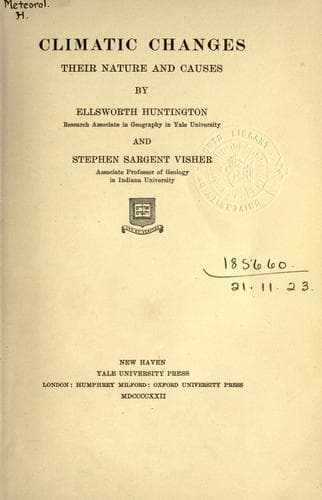
Climatic Changes: Their Nature and CausesHuntington, Ellsworth
Science
Climatic Changes: Their Nature and Causes
Huntington, Ellsworth
Climatic changes; Climatology; Paleoclimatology
III. Throughout geological history there is abundant evidence that the
process of contraction has led to marked differences not only in the
distribution and area of the lands, but in their height. On the whole
the lands have presumably increased in height since the Proterozoic,
somewhat in proportion to the increased differentiation of continents
and oceans.[89] If there has been such an increase, the contrast between
the climate of ocean and land must have been accentuated, for highlands
have a greater diurnal and seasonal range of temperature than do
lowlands. The ocean has very little range of either sort. The large
range at high altitudes is due chiefly to the small quantity of water
vapor, for this declines steadily with increased altitude. A diminution
in the density of the other constituents of the air also decreases the
blanketing effect of the atmosphere. In conformity with the great
seasonal range in temperature at times when the lands stand high, the
direction of the wind would be altered. When the lands are notably
warmer than the oceans, the winds commonly flow from land to sea, and
when the continents are much colder than the oceans, the direction is
reversed. The monsoons of Asia are examples. Strong seasonal winds
disturb the normal planetary circulation of the trade winds in low
latitudes and of the westerlies in middle latitudes. They also interfere
with the ocean currents set in motion by the planetary winds. The net
result is to hinder the transfer of heat from low latitudes to high, and
thus to increase the contrasts between the zones. Local as well as zonal
contrasts are also intensified. The higher the land, the greater,
relatively speaking, are the cloudiness and precipitation on seaward
slopes, and the drier the interior. Indeed, most highlands are arid.
Henry's[90] recent study of the vertical distribution of rainfall on
mountain-sides indicates that a decrease sets in at about 3500 feet in
the tropics and only a little higher in mid-latitudes.
Public-domain text, read in full here on John Shaqi.
Reviews
Reviews
No reviews yet
Be the first to share your thoughts on this work.
Elsewhere in the archive
Join the Discussion
Join the discussion
Sign in to leave a comment or review.
Sign InorCreate an account