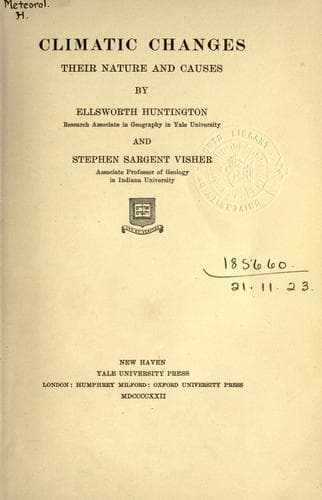
Climatic Changes: Their Nature and CausesHuntington, Ellsworth
Science
Climatic Changes: Their Nature and Causes
Huntington, Ellsworth
Climatic changes; Climatology; Paleoclimatology
In order to contribute enough heat to raise the surface temperature
1 deg.C., the temperature gradient from the interior of the earth to the
surface would need to be ten times as great as now, for the rate of
conduction varies directly with the gradient. If the gradient were ten
times as great as now, the rocks at a depth of two and one-half miles
would be so hot as to be almost liquid according to Barrell's[94]
estimates. The thick strata of unmetamorphosed Paleozoic rocks indicate
that such high temperatures have not prevailed at such slight depths
since the Proterozoic. Furthermore, the fact that the climate was cold
enough to permit glaciation early in the Proterozoic era and at from one
to three other times before the opening of the Paleozoic suggests that
the rate of escape of heat was not rapid even in the first half of the
earth's recorded history. Yet even if the general escape of heat has
never been large since the beginning of the better-known part of
geological history, it was presumably greater in early times than at
present.
If there actually has been an appreciable decrease in the amount of heat
given out by the earth's interior, its effects would agree with the
observed conditions of the geological record. It would help to explain
the relative mildness of zonal, seasonal, and local contrasts of climate
in early geological times, but it would not help to explain the long
oscillations from era to era which appear to have been of much greater
importance. Those oscillations, so far as we can yet judge, may have
been due in part to solar changes, but in large measure they seem to be
explained by variations in the extent, distribution, and altitude of the
lands. Such variations appear to be the inevitable result of the earth's
contraction.
FOOTNOTES:
[Footnote 70: Chas. Schuchert: The Earth's Changing Surface and Climate
during Geologic Time; in Lull: The Evolution of the Earth and Its
Inhabitants, 1918, p. 55.]
[Footnote 71: Quoted by J. Cornet: Cours de Geologie, 1920, p. 330.]
[Footnote 72: T. C. Chamberlin: The Order of Magnitude of the Shrinkage
of the Earth; Jour. Geol., Vol. 28, 1920, pp. 1-17, 126-157.]
[Footnote 73: G. I. Taylor: Philosophical Transactions, A. 220, 1919,
pp. 1-33; Monthly Notices Royal Astron. Soc., Jan., 1920, Vol. 80,
p. 308.]
[Footnote 74: J. Jeffreys: Monthly Notices Royal Astron. Soc., Jan.,
1920, Vol. 80, p. 309.]
[Footnote 75: E. W. Brown: personal communication.]
[Footnote 76: C. S. Slichter: The Rotational Period of a Heterogeneous
Spheroid; in Contributions to the Fundamental Problems of Geology, by
T. C. Chamberlin, _et al._, Carnegie Inst. of Wash., No. 107, 1909.]
[Footnote 77: E. Suess: The Face of the Earth, Vol. II, p. 553, 1901.]
[Footnote 78: Chas. Schuchert: The Earth's Changing Surface and Climate;
in Lull: The Evolution of the Earth and Its Inhabitants, 1918, p. 78.]
Public-domain text, read in full here on John Shaqi.
Reviews
Reviews
No reviews yet
Be the first to share your thoughts on this work.
Elsewhere in the archive
Join the Discussion
Join the discussion
Sign in to leave a comment or review.
Sign InorCreate an account