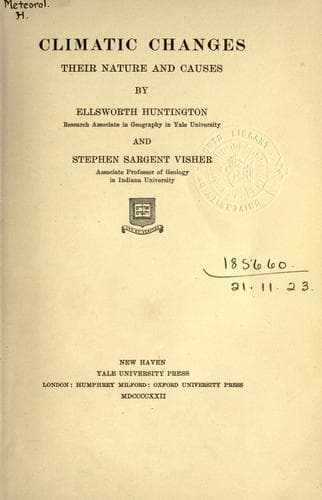
Climatic Changes: Their Nature and CausesHuntington, Ellsworth
Science
Climatic Changes: Their Nature and Causes
Huntington, Ellsworth
Climatic changes; Climatology; Paleoclimatology
The climatic effects of such extensive lava flows would be essentially
as follows: In the first place so long as the lavas were hot they would
set up a local system of convection with inflowing winds. This would
interfere at least a little with the general winds of the area. Again,
where the lava flowed out into water, or where rain fell upon hot lava,
there would be rapid evaporation which would increase the rainfall. Then
after the lava had cooled, it would still influence climate a trifle in
so far as its color was notably darker or lighter than that of the
average surface. Dark surfaces absorb solar heat and become relatively
warm when the sun shines upon them. Dark objects likewise radiate heat
more rapidly than light-colored objects. Hence they cool more rapidly at
night, and in the winter. As most lavas are relatively dark they
increase the average diurnal range of temperature. Hence even after they
are cool they increase the climatic diversity of the land.
The amount of heat given to the atmosphere by an extensive lava flow,
though large according to human standards, is small compared with the
amount received from the sun by a like area, except during the first few
weeks or months before the lava has formed a thick crust. Furthermore,
probably only a small fraction of any large series of flows occurred in
a given century or millennium. Moreover, even the largest lava flows
covered an area of only a few hundredths of one per cent of the earth's
surface. Nevertheless, the conditions which modify climate are so
complicated that it would be rash to state that this amount of
additional heat has been of no climatic significance. Like the
proverbial "straw that broke the camel's back," the changes it would
surely produce in local convection, atmospheric pressure, and the
direction of the wind may have helped to shift the paths of storms and
to produce other complications which were of appreciable climatic
significance.
V. The last point which we shall consider in connection with the effect
of the earth's interior upon climate is internal heat. The heat given
off by lavas is merely a small part of that which is emitted by the
earth as a whole. In the earliest part of geological history enough heat
may have escaped from the interior of the earth to exert a profound
influence on the climate. Knowlton,[92] as we have seen, has recently
built up an elaborate theory on this assumption. At present, however,
accurate measurements show that the escape of heat is so slight that it
has no appreciable influence except in a few volcanic areas. It is
estimated to raise the average temperature of the earth's surface less
than 0.1 deg.C.[93]
Public-domain text, read in full here on John Shaqi.
Reviews
Reviews
No reviews yet
Be the first to share your thoughts on this work.
Elsewhere in the archive
Join the Discussion
Join the discussion
Sign in to leave a comment or review.
Sign InorCreate an account