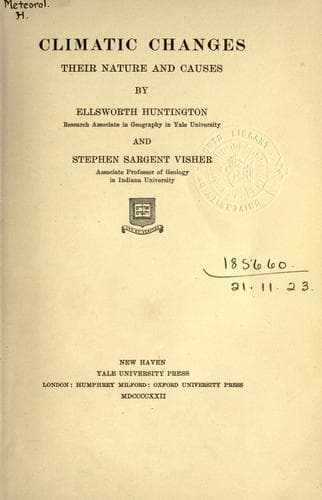
Climatic Changes: Their Nature and CausesHuntington, Ellsworth
Science
Climatic Changes: Their Nature and Causes
Huntington, Ellsworth
Climatic changes; Climatology; Paleoclimatology
1. The Last Great Arctic climate. 30,000-18,000 B. C.
Glaciation.
2. The Retreat of the Severe continental 18,000-6000 B. C.
Glaciers. climate.
3. The Continental Phase. Continental climate. 6000-4000 B. C.
4. The Maritime Phase. Warm and moist. 4000-3000 B. C.
5. The Later Forest Phase. Warm and dry. 3000-1800 B. C.
6. The Peat-Bog Phase. Cooler and moister. 1800 B. C.-300 A. D.
7. The Recent Phase. Becoming drier. 300 A. D.-
Brooks bases his chronology largely on De Geer's measurements of the
annual layers of clay in lake bottoms but makes much use of other
evidence. According to Brooks the last glacial epoch lasted roughly from
30,000 to 18,000 B. C., but this includes a slight amelioration of
climate followed by a readvance of the ice, known as the Buhl stage.
During the time of maximum glaciation the British Isles stood twenty or
thirty feet higher than now and Scandinavia was "considerably" more
elevated. The author believes that this caused a fall of 1 deg.C. in the
temperature of the British Isles and of 2 deg.C. in Scandinavia. By an
ingenious though not wholly convincing method of calculation he
concludes that this lowering of temperature, aided by an increase in the
area of the lands, sufficed to start an ice sheet in Scandinavia. The
relatively small area of ice cooled the air and gave rise to an area of
high barometric pressure. This in turn is supposed to have caused
further expansion of the ice and to have led to full-fledged glaciation.
About 18,000 B. C. the retreat of the ice began in good earnest. Even
though no evidence has yet been found, Brooks believes there must have
been a change in the distribution of land and sea to account for the
diminution of the ice. The ensuing millenniums formed the Magdalenian
period in human history, the last stage of the Paleolithic, when man
lived in caves and reindeer were abundant in central Europe.[96] At
first the ice retreated very slowly and there were periods when for
scores of years the ice edge remained stationary or even readvanced.
About 10,000 B. C. the edge of the ice lay along the southern coast of
Sweden. During the next 2000 years it withdrew more rapidly to about
59 deg.N. Then came the Fennoscandian pause, or Gschnitz stage, when for
about 200 years the ice edge remained in one position, forming a great
moraine. Brooks suggests that this pause about 8000 B. C. was due to the
closing of the connection between the Atlantic Ocean and the Baltic Sea
and the synchronous opening of a connection between the Baltic and the
White Seas, whereby cold Arctic waters replaced the warmer Atlantic
waters. He notes, however, that about 7500 B. C. the obliquity of the
ecliptic was probably nearly 1 deg. greater than at present. This he
calculates to have caused the climate of Germany and Sweden to be 1 deg.F.
colder than at present in winter and 1 deg.F. warmer in summer.
Public-domain text, read in full here on John Shaqi.
Reviews
Reviews
No reviews yet
Be the first to share your thoughts on this work.
Elsewhere in the archive
Join the Discussion
Join the discussion
Sign in to leave a comment or review.
Sign InorCreate an account