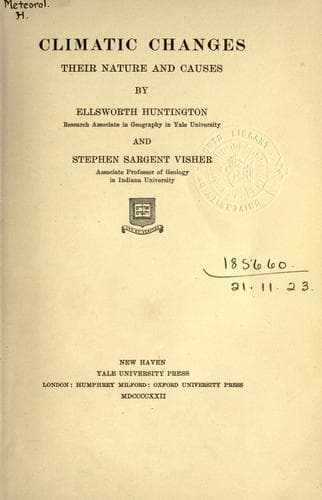
Climatic Changes: Their Nature and CausesHuntington, Ellsworth
Science
Climatic Changes: Their Nature and Causes
Huntington, Ellsworth
Climatic changes; Climatology; Paleoclimatology
The next climatic stage was marked by a rise of temperature till about
6000 B. C. During this period the ice at first retreated, presumably
because the climate was ameliorating, although no cause of such
amelioration is assigned. At length the ice lay far enough north to
allow a connection between the Baltic and the Atlantic by way of Lakes
Wener and Wetter in southern Sweden. This is supposed to have warmed the
Baltic Sea and to have caused the climate to become distinctly milder.
Next the land rose once more so that the Baltic was separated from the
Atlantic and was converted into the Ancylus lake of fresh water. The
southwest Baltic region then stood 400 feet higher than now. The result
was the Daun stage, about 5000 B. C., when the ice halted or perhaps
readvanced a little, its front being then near Ragunda in about latitude
63 deg.. Why such an elevation did not cause renewed glaciation instead of
merely the slight Daun pause, Brooks does not explain, although his
calculations as to the effect of a slight elevation of the land during
the main period of glaciation from 30,000 to 18,000 B. C. would seem to
demand a marked readvance.
After 5000 B. C. there ensued a period when the climate, although still
distinctly continental, was relatively mild. The winters, to be sure,
were still cold but the summers were increasingly warm. In Sweden, for
example, the types of vegetation indicate that the summer temperature
was 7 deg.F. higher than now. Storms, Brooks assumes, were comparatively
rare except on the outer fringe of Great Britain. There they were
sufficiently abundant so that in the Northwest they gave rise to the
first Peat-Bog period, during which swamps replaced forests of birch and
pine. Southern and eastern England, however, probably had a dry
continental climate. Even in northwest Norway storms were rare as is
indicated by remains of forests on islands now barren because of the
strong winds and fierce storms. Farther east most parts of central and
northern Europe were relatively dry. This was the early Neolithic period
when man advanced from the use of unpolished to polished stone
implements.
Not far from 4000 B. C. the period of continental climate was replaced
by a comparatively moist maritime climate. Brooks believes that this was
because submergence opened the mouth of the Baltic and caused the fresh
Ancylus lake to give place to the so-called Litorina sea. The
temperature in Sweden averaged about 3 deg.F. higher than at present and in
southwestern Norway 2 deg.. More important than this was the small annual
range of temperature due to the fact that the summers were cool while
the winters were mild. Because of the presence of a large expanse of
water in the Baltic region, storms, as our author states, then crossed
Great Britain and followed the Baltic depression, carrying the moisture
far inland. In spite of the additional moisture thus available the snow
line in southern Norway was higher than now.
Public-domain text, read in full here on John Shaqi.
Reviews
Reviews
No reviews yet
Be the first to share your thoughts on this work.
Elsewhere in the archive
Join the Discussion
Join the discussion
Sign in to leave a comment or review.
Sign InorCreate an account