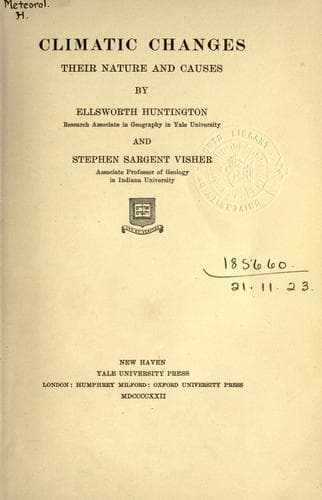
Climatic Changes: Their Nature and CausesHuntington, Ellsworth
Science
Climatic Changes: Their Nature and Causes
Huntington, Ellsworth
Climatic changes; Climatology; Paleoclimatology
During past ages, when the sea water was less salty, the circulation was
presumably more rapid than now. This was because, in tropical regions,
the rise of cold water is hindered by the sinking of warm surface water
which is relatively dense because evaporation has removed part of the
water and caused an accumulation of salt. According to Kruemmel and
Mill,[103] the surface salinity of the subtropical belt of the North
Atlantic commonly exceeds 3.7 per cent and sometimes reaches 3.77 per
cent, whereas the underlying waters have a salinity of less than 3.5 per
cent and locally as little as 3.44 per cent. The other oceans are
slightly less saline than the North Atlantic at all depths, but the
vertical salinity gradients along the tropics are similar. According to
the Smithsonian Physical Tables, the difference in salinity between the
surface water and that lying below is equivalent to a difference of .003
in density, where the density of fresh water is taken as 1.000. Since
the decrease in density produced by warming water from the temperature
of its greatest density (4 deg.C.) to the highest temperatures which ever
prevail in the ocean (30 deg.C. or 86 deg.F.) is only .004, the more saline
surface waters of the dry tropics are at most times almost as dense as
the less saline but colder waters beneath the surface, which have come
from higher latitudes. During days of especially great evaporation,
however, the most saline portions of the surface waters in the dry
tropics are denser than the underlying waters and therefore sink, and
produce a temporary local stagnation in the general circulation. Such a
sinking of the warm surface waters is reported by Kruemmel, who detected
it by means of the rise in temperature which it produces at considerable
depths. If such a hindrance to the circulation did not exist, the
velocity of the deep-sea movements would be greater.
If in earlier times a more rapid circulation occurred, low latitudes
must have been cooled more than now by the rise of cold waters. At the
same time higher latitudes were presumably warmed by a greater flow of
warm water from tropical regions because less of the surface heat sank
in low latitudes. Such conditions would tend to lessen the climatic
contrast between the different latitudes. Hence, in so far as the rate
of deep-sea circulation depends upon salinity, the slowly increasing
amount of salt in the oceans must have tended to increase the contrasts
between low and high latitudes. Thus for several reasons, the increase
of salinity during geologic history seems to deserve a place among the
minor agencies which help to explain the apparent tendency toward a
secular progression of climate in the direction of greater contrasts
between tropical and subpolar latitudes.
Public-domain text, read in full here on John Shaqi.
Reviews
Reviews
No reviews yet
Be the first to share your thoughts on this work.
Elsewhere in the archive
Join the Discussion
Join the discussion
Sign in to leave a comment or review.
Sign InorCreate an account